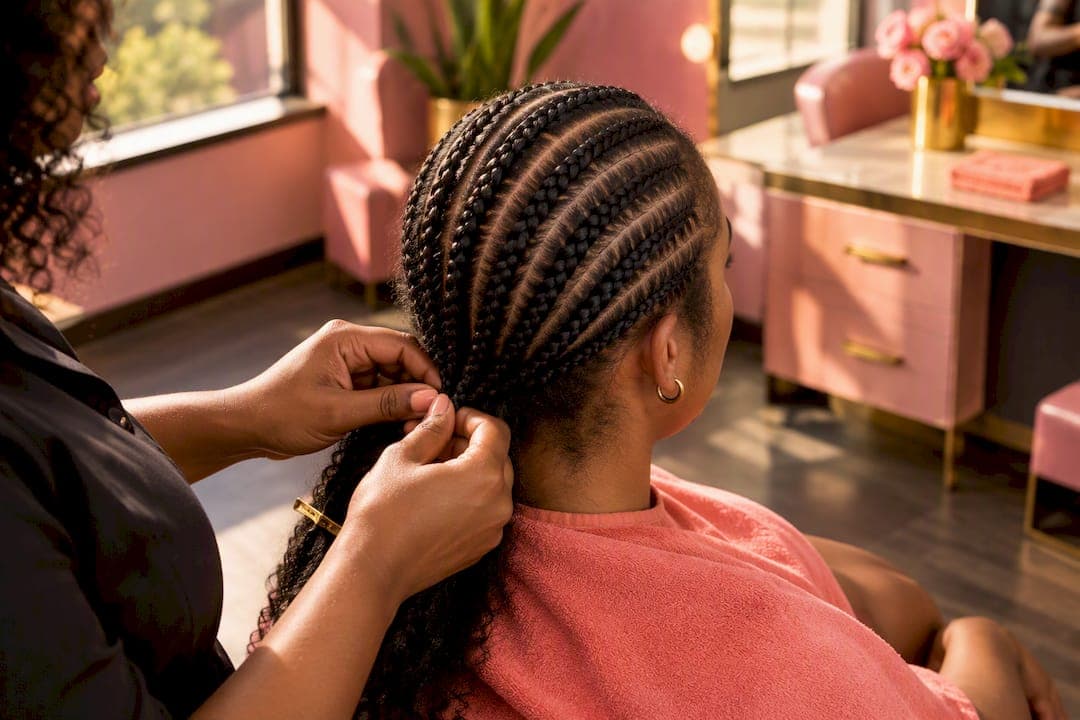
A sew-in braid down is the flat cornrow foundation your stylist builds before sewing in wefts, and the pattern you choose depends entirely on your install. Closures call for a beehive spiral, frontals and leave-out styles want straight-back rows, and versatile parting needs a four-quadrant vixen. Most braid-downs use 6 to 12 cornrows and take 25 to 90 minutes, depending on which pattern you pick.
TL;DR:
- Choosing the correct braid-down pattern is essential to prevent lumps and ensure longevity, with straight-back suited for frontals and leave-out styles, and vixen offering more versatility but requiring longer time.
- To avoid early looseness or slipping, the braid foundation must be flat, braid tightly but gently, and secure ends properly, while ensuring the scalp is clean and free of tension.
- A scalp showing pain, tenderness, redness, or bumps indicates excessive tension, and loosening the tightest rows immediately can prevent traction alopecia and damage.
- Most patterns require three bundles of hair, with larger or more complex styles like vixen needing up to four, and appointment time varies based on pattern complexity.
- Proper washing, drying, and gentle removal methods are crucial for maintaining scalp health and avoiding damage when taking down a sew-in.
Table of Contents
- Which Braid-Down Pattern Fits Your Install?
- How Do You Braid Down for a Sew-In Step by Step?
- What Does the AAD Say About Tension and Scalp Health?
- What Should You Bring or Book for a Braid Down?
- How Do You Wash, Dry, and Remove a Sew-In Safely?
- Salon-Tested Tips for a Flatter, Safer Braid Down
- What Rushing a Sew-In Actually Costs You
- How Afro Magic Braiding Handles Your Sew-In Braid Down
- Sources
- FAQ
Which Braid-Down Pattern Fits Your Install?
Every install has a matching pattern, and picking the wrong one is the fastest way to a lumpy, short-lived sew-in. Here's how the main patterns break down and where each one earns its place.
- Straight-back: Rows run front to back in parallel lines. It suits frontals and leave-out installs because the flat, uniform surface blends easily under a lace edge or a parted-out strip. Expect roughly between a quarter to two-thirds of an hour.
- Beehive (closure pattern): A spiral of rows circles inward toward the crown, leaving a flat, seamless center for a closure piece to sit over. It runs longer, often 40 to 60 minutes, because the spiral needs precise, tightening curves.
- Lace frontal pattern: Similar to straight-back but with fewer rows near the hairline to reduce bulk under sheer lace. Fewer cornrows mean less time, usually between half an hour and three-quarters of an hour.
- Vixen: The head is split into four quadrants, which gives you natural-looking versatility for parting and updos later. It's the most labor-intensive pattern, often taking 60 to 90 minutes because of the extra sectioning and cornrow count.
More cornrows generally mean a flatter foundation but a longer chair time, so the trade-off is precision versus speed.
How Do You Braid Down for a Sew-In Step by Step?
A rushed foundation shows up later as lumps, slipping tracks, or a weave that lifts at the crown within weeks. Here's the process that prevents that.
- Wash and deep condition. Clarify first to strip product buildup, then deep condition so hair is soft enough to part cleanly. Skipping this step is a common cause of lumps and premature loosening.
- Detangle and stretch. Blow-dry on low heat or use a stretching method so each section lies flat instead of coiling under the braid.
- Gather your tools. A rat-tail comb for clean parts, duckbill clips to manage sections, a light edge control or gel, and synthetic braiding hair (often Kanekalon) if you need extra grip or length for the cornrow itself.
- Section with intention. Map the full pattern before you braid a single row. Clean, straight parts matter more than speed here.
- Braid flat, not tight. Use thumb pressure to press each row down as you go, rather than pulling upward. Checking flatness row by row, instead of at the end, is standard salon practice.
- Secure the ends. Loop and tuck small ends, or seal them with a light band, so the tail doesn't unravel before the weft goes on.
Pro Tip: Run your fingers across each finished row before moving to the next. If you feel a ridge or a raised bump, redo it now. Once the weft is sewn on top, a lumpy row is far harder to fix.
What Does the AAD Say About Tension and Scalp Health?
Pain is not a normal part of getting a sew-in, and it's the clearest warning sign your foundation is too tight. The American Academy of Dermatology points out that tight cornrows and weaves can trigger traction alopecia, a form of hair loss caused by sustained pulling at the follicle. The AAD's guidance is direct: loosen the style, and remove a weave right away if it hurts or irritates your scalp.
Watch for these signals during and after your braid-down:
- Sharp pain while a row is being braided
- A dull headache that starts once the style is finished
- Persistent tenderness or burning at the hairline
- Redness or small bumps along the parts
If any of these show up, ask your stylist to loosen the row on the spot, check the perimeter rows first since corners take the most stress, and favor thicker, less-compressed rows right at your hairline. Give your scalp a break between heavy installs, and read more on scalp tension causes and relief if soreness has become a pattern for you.
What Should You Bring or Book for a Braid Down?
Preparation makes the appointment faster and the result more durable. Bring a rat-tail comb, sectioning clips, a light-hold edge product, a scalp oil, and synthetic braiding hair if your stylist recommends adding it into the cornrow for extra grip.
- Most patterns need about 3 bundles of weft hair; a vixen install sometimes needs a fourth for full coverage across four quadrants.
- Book your appointment allowing enough time for the pattern you choose, as times vary based on complexity and style.
- Some stylists braid a strip of synthetic hair into the cornrow itself, which gives the weft's thread something firmer to grip and can extend how long the install holds.
How Do You Wash, Dry, and Remove a Sew-In Safely?
A sew-in isn't wash-and-forget. The scalp underneath still needs cleansing and complete drying, since trapped moisture invites odor, mildew, and matting.
- Wash every 1 to 2 weeks with a diluted shampoo applied at the scalp, then rinse thoroughly.
- Dry completely, ideally under a hooded dryer, before styling or sleeping. Damp cornrows underneath a sewn weft rarely dry on their own.
- Check weekly for loose rows, edge loading near the hairline, or any row that feels tighter than the rest.
- To remove, snip the thread carefully at the tracks, never the cornrows themselves, then unravel each row slowly and deep condition right after.
If you can't easily access your scalp to wash and dry it, a tape-in or clip-in method may serve you better than a continuous sew-in. For more on keeping the scalp comfortable through the wear cycle, see these scalp care strategies for braids, and consider a lightweight oil routine like the one in this scalp oil ritual guide between wash days.
Salon-Tested Tips for a Flatter, Safer Braid Down
After years of braiding downs at the chair, a few small adjustments consistently make the difference between a foundation that lasts and one that loosens by week two. Widen the outer rows at your perimeter, since corners absorb the most pulling force, and space the stitches slightly wider there to ease pressure. For fragile edges, a feed-in or knotless technique at the hairline holds the weft just as well without loading the edge.
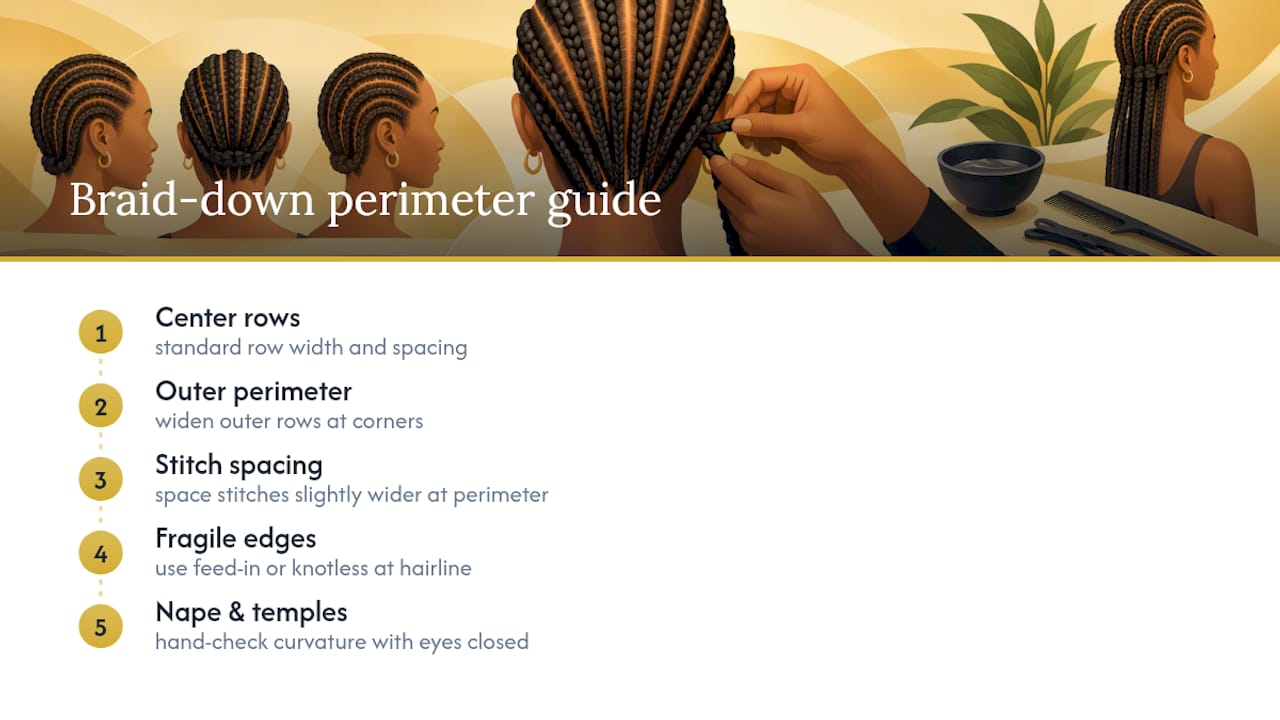
Pro Tip: Before sewing, run your hand over the whole braided head with your eyes closed. Your fingers catch curvature and stitch spacing issues your eyes miss, especially near the nape and temples.
What Rushing a Sew-In Actually Costs You
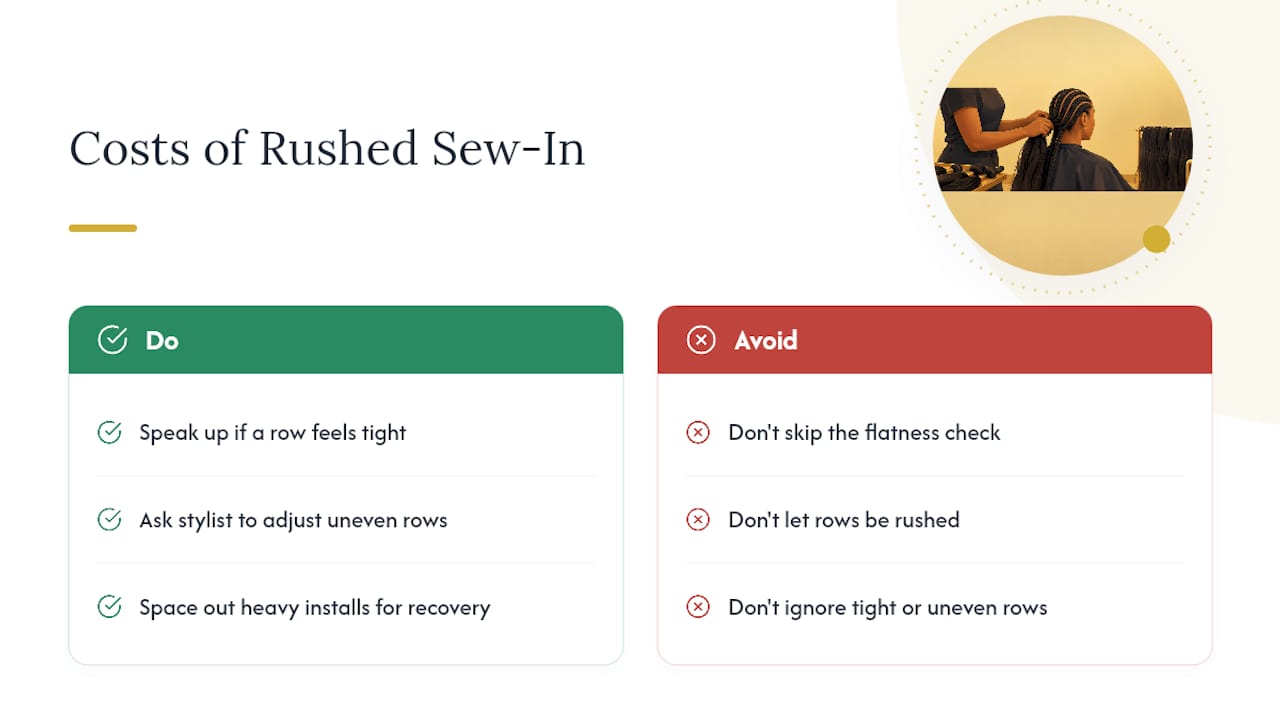
The mistake I see most isn't a bad pattern choice. It's speed. A stylist or a client under time pressure skips the flatness check on row four because rows five through ten are waiting, and that one uneven row becomes the spot where the weave lifts three weeks later.
Speak up the moment a row feels tighter than the others. It's your scalp, and a good stylist would rather adjust one row now than remove your whole style early. Space out heavy installs so your hairline gets real recovery time between them.
— Afro
How Afro Magic Braiding Handles Your Sew-In Braid Down
There are ways to learn this pattern yourself, and plenty of tutorials will walk you through a straight-back row at home. But a beehive spiral or a vixen quadrant install rewards a trained hand, because one uneven row under a full weft is much harder to fix than one uneven row on its own. A professional salon builds every sew-in braid-down to match your specific install tailored to your needs, using techniques that minimize tension at the perimeter where hair is most fragile.

Come to your appointment with clean, detangled hair (or book a wash beforehand), and tell your braider directly if any row feels tight while it's being placed. Browse real finished installs in the braiding portfolio, then book your sew-in appointment to get a foundation built for your pattern, not a generic one.
Sources
- Hairstyles that pull can lead to hair loss | American Academy of Dermatology
- Sew-In Braid Patterns: 6 Braid Downs for Every Install | Mayvenn
- Sew-in wefts (Conde Professional)
FAQ
What Is the Best Braid-Down Pattern for a Sew-In?
There's no single best pattern; it depends on your install. A beehive suits closures, straight-back works for frontals and leave-out, and vixen gives you the most parting flexibility afterward.
How Do You Do a Sew-In Braid Down?
Wash and deep condition first, then section the head into a clean pattern before braiding flat cornrows with thumb pressure, checking flatness row by row. Secure each braid's end before the weft is sewn on top.
What Are the Downsides of Sew-In Hair Extensions?
The main risks are tension-related: cornrows that are too tight can pull on the hairline and lead to traction alopecia, according to the American Academy of Dermatology. The scalp underneath also needs full washing and drying, which some people find harder to manage than other extension methods.
Are Sew-Ins Better Than Braids?
They serve different goals rather than one being universally better. A sew-in gives you a straighter, weave-based texture over a braided foundation, while braids alone are a full protective style on their own, and Afro Magic Braiding offers both as separate services on its portfolio.
How Many Cornrows Does a Braid Down Need?
Most patterns use 6 to 12 cornrows, with simpler straight-back styles on the lower end and beehive or vixen patterns needing more rows for their spiral or quadrant shape.