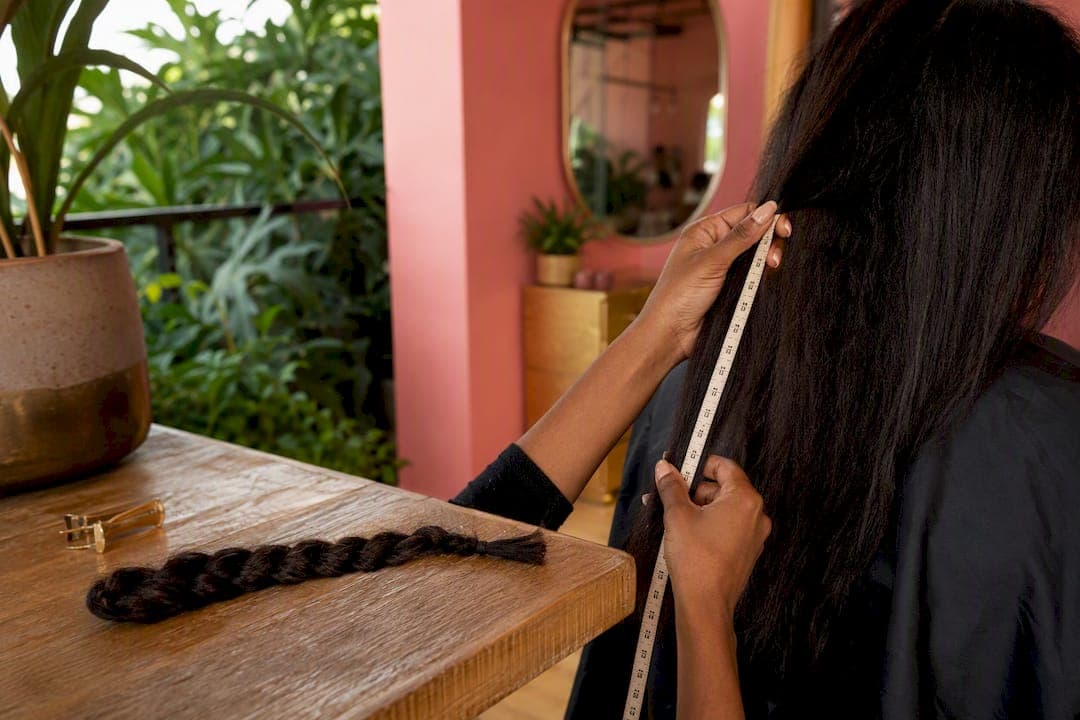
The short formula: packs needed = (number of braids across your head × length per braid with allowance) ÷ pack yield, rounded up. For medium box braids finished at mid-back length, that math lands most people at 3 packs.
Here's the fast version before we walk through the full method: measure your desired finished length and add 2 to 3 inches for the fold and installation loop. Use a coin or your index finger as a width guide for medium braids if you don't have a ruler handy. Most full heads of shoulder-length medium braids use about 2.5 packs, mid-back needs 3 to 3.5 packs, and waist-length runs 3.5 to 4 packs or more.
- Per-braid length: measure from scalp to desired end point, then add fold-over allowance.
- Width rule: a nickel-to-quarter width equals a medium braid; a pencil eraser equals micro.
- Common counts: 2 packs for light/short styles, 3 packs for most full-head medium looks, 4+ for waist-length or extra-full installs.
Pro Tip: If you're unsure which way to round, round up. A leftover pack costs you a few dollars; running short mid-install costs you a wasted trip and mismatched hair from a different dye lot.
If you want a salon eye on the math before you buy, Afro Magic Braiding checks client measurements against real install data every week, and that comparison is where the rest of this guide comes from.
Key Takeaways
Accurate braiding hair quantity comes down to three numbers: braid count, per-braid length with allowance, and pack yield, multiplied together and rounded up.
| Point | Details |
|---|---|
| Formula drives the decision | Packs needed = (braid count × length per braid with allowance) ÷ pack yield, rounded up. |
| Length changes the math most | Waist-length installs commonly need 3.5 to 4 packs versus 2.5 for shoulder-length medium braids. |
| Knotless needs extra allowance | Add 1 to 3 inches per braid for knotless installs due to the feed-in technique. |
| Texture shifts the count | Thicker natural hair often needs fewer packs for the same visual fullness than fine hair. |
| Afro Magic Braiding confirms it | Afro Magic Braiding runs a sample-braid yield test during consultations to verify pack counts before install. |
Table of Contents
- How to Measure Braiding Hair Quantity Step by Step
- Packs-Needed Estimates by Braid Size and Length
- Knotless Braids: Why Sizing Works Differently
- How Salons Like Afro Magic Braiding Measure Braiding Hair
- Common Mistakes That Throw Off Your Hair Estimate
- Your Printable Braiding Hair Measuring Cheat Sheet
- What Most Guides Get Wrong About Pack Counts
- Get a Professional Measurement Check at Afro Magic Braiding
- Frequently Asked Questions
- Sources
How to Measure Braiding Hair Quantity Step by Step
Grab these four items before you start: a soft measuring tape, a ruler for double-checking short segments, one sample braid from a pack you already own (or plan to buy), and a hair clip or marker to mark test sections. If you don't own a measuring tape, a standard dollar bill is about 6 inches long and works as a rough guide.
Step 1: Measure your natural hair length and target finished length. Stretch a small section of your natural hair (or have someone hold it) and measure from root to end in inches. Then decide your finished braid length and measure that on a straight edge, scalp to tip.
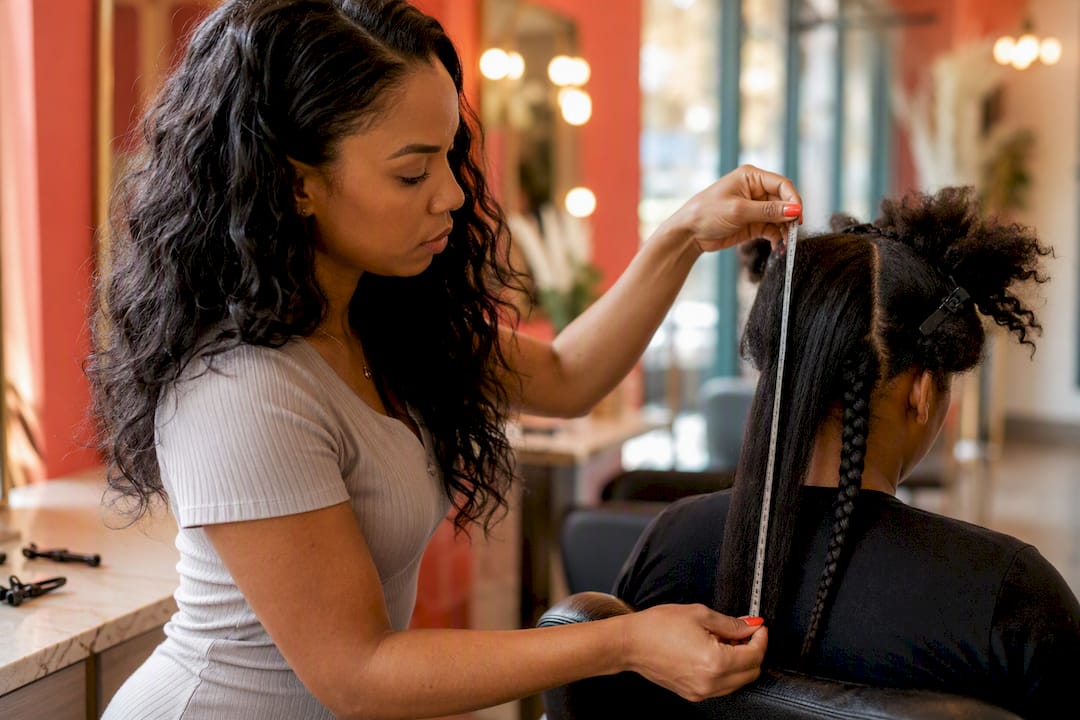
Step 2: Add installation allowance. Braiding hair folds over your natural hair at the root, so the piece you cut or pull from the pack needs to run longer than the finished braid. Add 2 to 3 inches for classic box braids to cover the fold and knot point.
Step 3: Measure braid width and estimate braid count. Wrap the tape around your head at the point where you'll part your hairline (roughly where a headband sits) to get head circumference. Divide that number by your target braid width in inches. A quarter-inch part gives you small braids; a half-inch part gives you medium. Divide circumference by the part width to estimate how many braids you'll need across the front row, then extrapolate for full coverage using your parting plan.
Step 4: Convert braid count into pack count. This is where the sample-braid trick matters most. Braid one full strand from a single pack at your target length and width, then count how many identical braids that same pack could realistically produce. Multiply your total braid count by your per-braid length, divide by what one pack yields, and round up.
No tools on hand? Use your index finger as a width gauge: one finger width is roughly a medium braid, two fingers signals large or jumbo, and a pencil-thin gap means micro. A coin (nickel-sized) also approximates medium width in a pinch.
Pro Tip: Thicker, coarser natural hair holds braids fuller with less added hair, while fine or thin natural hair usually needs extra packs to hit the same visual density. Sectioning your hair evenly before you measure also keeps your braid-count estimate consistent instead of guessing section by section.
Packs-Needed Estimates by Braid Size and Length
Once you know your braid size and target length, the pack count question gets a lot simpler. The table below reflects common salon and supplier guidance for full-head installs on average-density hair.
| Braid Size | Shoulder Length | Mid-Back Length | Waist Length | Allowance Added | Weight & Comfort Note |
|---|---|---|---|---|---|
| Micro | 3 to 4 packs | 4 to 5 packs | 5+ packs | 2 inches per strand | Many thin strands add up in weight; check scalp tension after install |
| Small | 3 packs | 3.5 to 4 packs | 4 packs | 2 to 2.5 inches | Lighter than micro per braid but higher strand count overall |
| Medium | 2.5 packs | 3 to 3.5 packs | 3.5 to 4 packs | 2.5 to 3 inches | Best comfort-to-fullness ratio for most first-time buyers |
| Large/Jumbo | 2 packs | 2.5 packs | 3 packs | 3 inches | Fewer braids means less overall weight on the scalp |
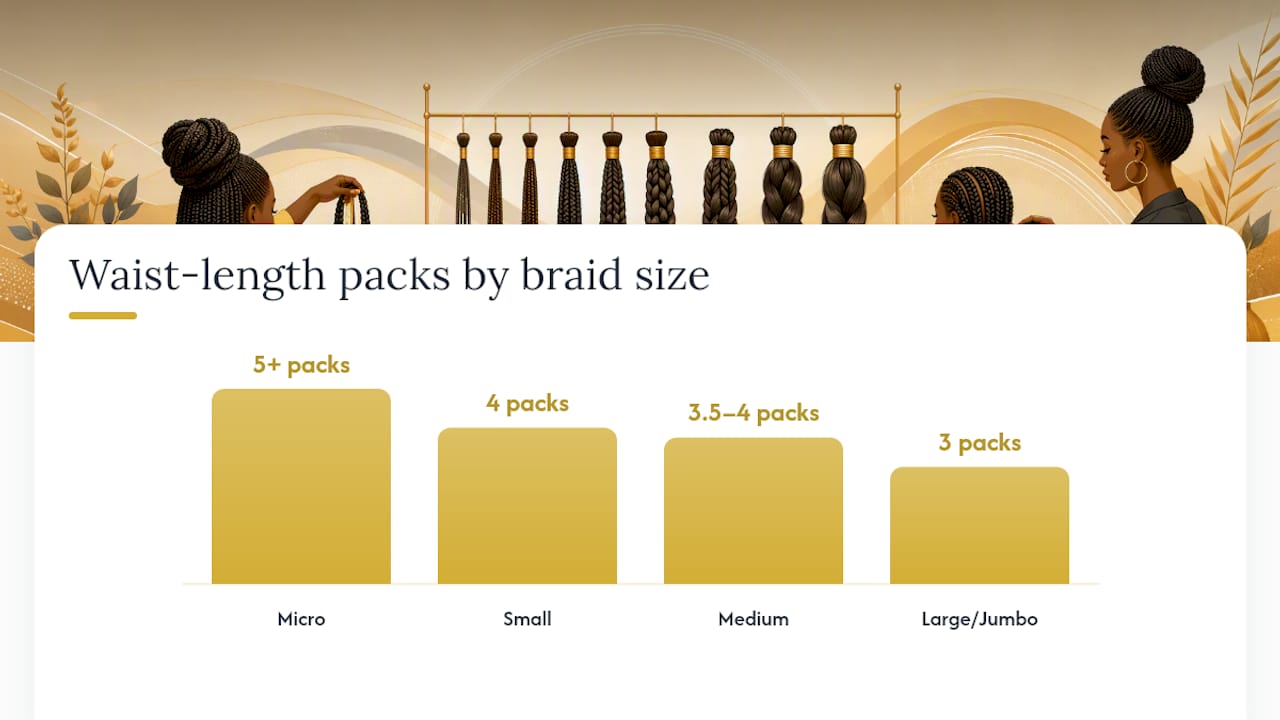
These estimates line up with commonly cited guidance that shoulder-length medium braids need roughly 2.5 packs while waist-length climbs to 3.5 to 4 packs or more, and that waist-length itself typically measures 28 to 30 inches from scalp to tip when you're checking your own ruler measurement against the chart.
Two packs can work for lighter, lower-density styles, but three packs is the more common recommendation once you want a fuller, salon-finished look and some room for trimming mistakes.
A few things shift these numbers in either direction. Coarser or thicker natural hair often needs fewer packs for the same visual fullness, since your own hair fills in gaps that finer hair leaves open. Pre-stretched hair also behaves differently than un-stretched bulk hair. Pre-stretched packs are pre-separated and ready to use, which usually means less waste per braid, while un-stretched hair requires more pulling and separating and can burn through material faster.
Pro Tip: When your calculation lands right between two whole numbers, always round up rather than down. Buying one extra pack costs a few dollars; running short mid-install means hunting for a matching dye lot at a different store, and lot color rarely matches exactly.
| Point | Details |
|---|---|
| Medium is the safest default | Medium braids balance pack cost, install time, and comfort better than micro or jumbo for first-time buyers. |
| Length drives pack count most | Moving from shoulder to waist length can add a full extra pack or more regardless of braid size. |
| Round up, not down | A spare pack costs little; a mid-install shortage risks a mismatched dye lot. |
Knotless Braids: Why Sizing Works Differently
Knotless braids change the math because the technique itself is different. Instead of tying a knot at the root and clipping extension hair on, knotless installs feed the extension hair in gradually as the braid grows, which means less bulk sits at your scalp. That's the appeal, but it also means the extension piece you start with often needs to run longer than what classic box braids require to reach the same finished length.
Salons commonly add 1 to 3 extra inches of allowance per braid for knotless styles compared with classic box braids, since the feed-in method uses up more length before the braid pattern even becomes visible.
That extra length per braid doesn't always translate into more total packs. For medium knotless braids at mid-back length, expect to use roughly the same number of packs as classic box braids, sometimes slightly more depending on how tightly you feed the hair in. Micro knotless styles tend to need the biggest jump in pack count, since more individual braids each carry that extra feed-in allowance.
- Braid one sample knotless strand first and count exactly how many strands of that length one pack yields.
- Compare that yield against your total braid count from your parting plan, not against a generic pack estimate.
- If your sample braid uses more than expected, buy in half-pack increments rather than jumping a full extra pack.
Pro Tip: Salons often keep one pack in reserve specifically for knotless installs, since the feed-in technique makes it easy to underestimate how much length disappears into the first few inches of each braid before the visible pattern starts.
How Salons Like Afro Magic Braiding Measure Braiding Hair
Getting a salon-accurate number isn't guesswork. It follows a repeatable sequence that translates directly to what you can do at home or bring with you to an appointment.
- Consult on desired fullness and weight. A stylist asks how full you want the finished look and how much weight feels comfortable on your scalp before touching a measuring tape.
- Take head circumference and build a parting plan. This determines how many braids the full head actually needs, section by section.
- Run a sample-braid yield test. One braid from one pack tells the stylist exactly how far that hair stretches for your specific texture and chosen width.
- Mark extension length with full installation allowance, then finalize the pack count based on the yield test, not a generic chart.
If you want to bring accurate numbers to your own appointment, copy this checklist:
- Desired finished length (inches, scalp to tip)
- Braid width or size category (micro, small, medium, large)
- Preferred hair type: pre-stretched or un-stretched
- Natural hair texture and thickness
- Any style-specific notes (knotless vs. classic, boho curls, color)
Afro Magic Braiding runs this exact workflow for walk-in consultations, weighing client comfort and long-term hair health alongside fullness so you don't end up with a style that's technically full but too heavy to wear comfortably for six weeks. Bringing your own measurements and a reference photo to your appointment cuts consultation time significantly and helps the stylist confirm your pack estimate on the spot.
Common Mistakes That Throw Off Your Hair Estimate
Most miscalculations trace back to one of four habits, and each has a quick fix.
- Skipping installation allowance. Fix: always add 2 to 3 inches per braid (more for knotless) before you calculate total length needed.
- Ignoring shrinkage or stretch. Un-stretched hair behaves differently once wet or manipulated. Fix: use pre-stretched hair if you want your final measurement to match your calculation closely.
- Underestimating thick natural hair. Fix: if your natural hair is coarse or high-density, you can often drop your pack estimate by half a pack, since your own hair fills volume that finer hair wouldn't.
- Miscounting braid number. Fix: redo the circumference-divided-by-width math rather than eyeballing your parting plan.
What if I have one pack left over? Save it. Braiding hair keeps well in a sealed bag, and a leftover pack covers touch-ups or a smaller style later.
Can I mix brands or colors mid-install? You can, but slight texture or shine differences between brands sometimes show under bright light, so match within the same brand and dye lot whenever possible.
Your Printable Braiding Hair Measuring Cheat Sheet
Screenshot this before your next shopping trip or salon visit.
Three formulas to remember:
- Packs needed = (braid count × length per braid with allowance) ÷ pack yield, rounded up.
- Per-braid length = finished length + 2 to 3 inches (classic) or + 3 to 5 inches (knotless).
- Braid count = head circumference ÷ target braid width.
Checklist before you buy or book:
- Measuring tape or ruler
- One sample braid built and measured for yield
- Finished length and braid width written down
- Natural hair texture noted (fine, medium, coarse)
- Reference photo saved for your stylist
Pro Tip: Coarser hair often needs less added length and fewer packs for the same fullness, so adjust your final number down slightly if your natural hair runs thick. Bring your photo and this checklist to your appointment so your stylist can confirm the count in minutes, not guesswork.
| Point | Details |
|---|---|
| Formula first, shopping second | Calculate braid count and length before you buy so you're not estimating at the register. |
| Sample braid confirms yield | One test braid tells you exactly how far a pack stretches for your specific hair and width. |
What Most Guides Get Wrong About Pack Counts
Most quantity charts treat pack count like a fixed number tied only to length, and that's the part worth pushing back on. Length matters, but the sample-braid yield test matters more, because two people buying the "same" medium box braids at mid-back length can need noticeably different pack counts based on natural hair thickness alone.
The conventional advice skips texture almost entirely, which is backwards. A coarse-haired client and a fine-haired client following the same generic chart will end up with two different results: one slightly sparse, one carrying unnecessary extra weight and cost. The fix isn't a better chart. It's testing your own yield with one sample braid before you commit to buying four packs you might not need.
Knotless sizing gets even less attention in most guides, and that gap costs people money. Treating knotless like classic box braids without adding feed-in allowance is the single most common reason people run short mid-install. Prioritize the sample-braid test and the extra knotless allowance first. Everything else in this guide is refinement.
Get a Professional Measurement Check at Afro Magic Braiding
Doing the math yourself is a solid start, but nothing beats having a stylist confirm your numbers before you commit to a full install. Afro Magic Braiding is the alternative to guessing alone at home or over-ordering from an online hair shop: our stylists run the same sample-braid yield test described above on your actual hair, in person, before a single strand gets braided in.
If you're in the Southfield, Michigan area and want your knotless, box braid, or Fulani-style measurements checked by someone who does this daily, bring your finished-length target and a reference photo to your booking appointment. You can browse finished results in our portfolio first to settle on a length and fullness, then book directly online or by phone. Walking in with the right numbers means less time in the chair and a style that fits your comfort and hair health from the first row to the last.
Frequently Asked Questions
How many packs of braiding hair do I need for a full head? Most medium box braid installs use 2.5 to 4 packs depending on finished length, with mid-back length landing around 3 to 3.5 packs.
How do I measure per-braid length correctly? Measure your desired finished length scalp to tip, then add 2 to 3 inches for classic braids or 3 to 5 inches for knotless to account for the fold or feed-in technique.
Do I need more hair for knotless braids than classic box braids? Often about the same pack count, but each braid needs extra length allowance, so buy slightly more if your parting plan uses many small braids.
What if my natural hair is very thick? You can usually drop your pack estimate by half a pack, since coarse or dense natural hair fills in volume that finer hair needs added extensions to match.
Sources
- How Much Hair Should I Buy? The Complete Guide! - Unruly
- The Ultimate Guide to Braid Lengths Chart | Afro Hairdressers