
Protect knotless braids every night with satin or silk, whether that's a bonnet or a scarf paired with a wrap that fits your length: the triangle method, the cross-over, or a top bun for longer styles. Do this only after your braids are fully dry and lightly moisturized. Skip any of those three pieces and you're trading a few minutes now for weeks of frizz, dryness, or edge strain later.
TL;DR:
- Using a satin or silk bonnet or scarf after your braids are fully dry and lightly moisturized prevents frizz, dryness, and edge strain overnight.
- Long, heavy braids benefit from layered protection, such as a scarf plus a bonnet, while shorter styles can use a loose silk scarf alone to avoid unnecessary bulk.
- Wrapping methods like the triangle, cross-over, or top-bun are quick to master and suitable for different braid lengths, but over-tight wrapping can negate protection benefits.
- Edges are most vulnerable to tension from cotton pillowcases and tight wraps, so loosening your wrap and limiting styling tension supports edge health.
- Most knotless braid styles should be worn for 4 to 8 weeks with proper nightly care, and early touch-ups at week 4 help preserve your hairline better than pushing for maximum duration.
Table of Contents
- How Do You Prep Knotless Braids Before Bed?
- What's the Best Way to Wrap Knotless Braids at Night?
- Which Wrapping Method Works Best for Your Braid Length?
- How Do You Protect Your Edges Overnight?
- Salon-Tested Tips for Overnight Braid Care
- Salon Perspective: Wear Time vs. Edge Health
- Keep Your Braids Looking Salon-Fresh Between Visits
- Sources
- FAQ
How Do You Prep Knotless Braids Before Bed?
Wrapping technique matters, but it only works when the hair underneath it is ready. That means dry, lightly moisturized braids, not soaking wet ones and not overloaded ones either.
Wet or damp braids are the biggest overnight mistake in protective styling. Trapped moisture under a bonnet has nowhere to go, and that's exactly the environment that breeds mildew and a musty odor that lingers in the braid itself. If you washed your hair or your scalp in the evening, give your braids real time to air dry, or use a cool setting on a hooded dryer, before you wrap anything around them.
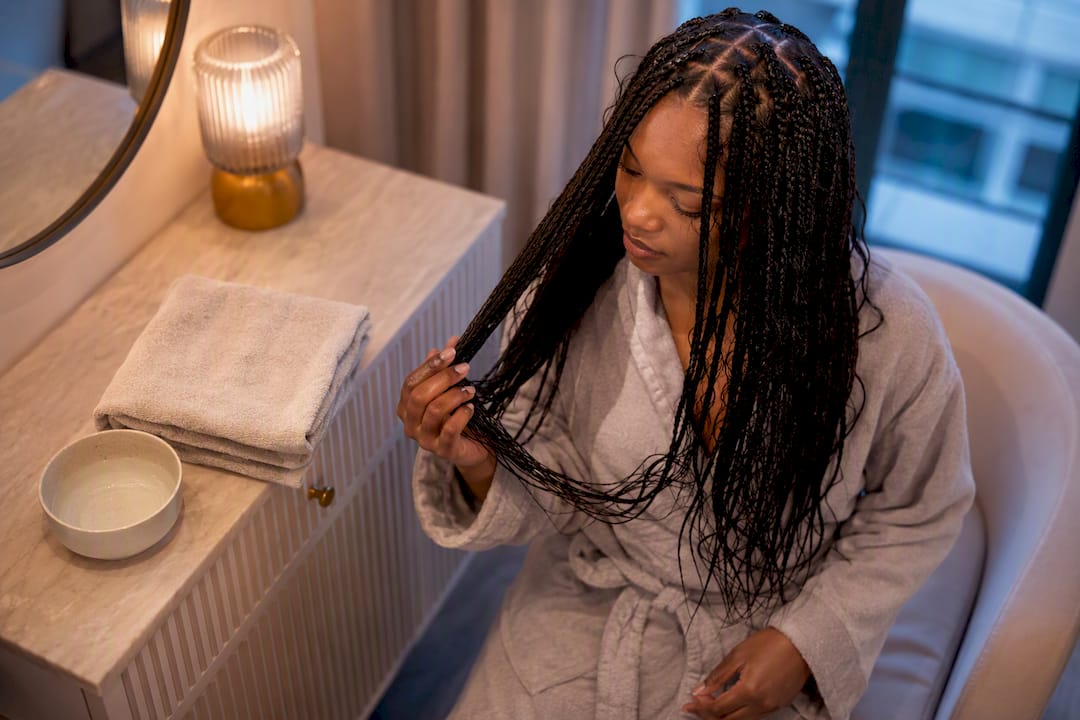
Once they're dry, moisture is still on the checklist, just in smaller doses. A light oil or a leave-in spray formulated for braided installs keeps the hair fiber from drying out without leaving a greasy film on your pillow. Apply it sparingly, mostly at the ends and along the length, and check our complete guide to knotless braid moisture if you're not sure how much is too much.
Your bonnet or scarf choice depends on braid length:
- Long, past-shoulder braids need a roomy satin bonnet with enough depth to hold a bun without pulling at the roots.
- Short to medium braids do fine with a standard silk scarf, tied loosely rather than cinched.
- Either option beats a cotton cap or scarf, which pulls moisture out of the hair and roughs up the braid's surface overnight.
Skip heavy gels or edge-control products before bed. They transfer onto satin, cake up near the hairline, and set you up for buildup that a wrap alone won't fix.
Pro Tip: If your scalp tends to get oily overnight, apply moisturizer to the mid-shaft and ends only, keeping the roots clean so you're not adding grease directly at the hairline where friction is already a risk.
What's the Best Way to Wrap Knotless Braids at Night?
Three wrapping methods cover almost every length and sleep style, and picking the right one takes less than sixty seconds once you know the sequence.
- Triangle method. Gather your braids at the crown and section the front hairline into a rough triangle shape, laying it flat against the scalp. Smooth the rest of the hair back and secure it with a loose band before covering everything with your bonnet or scarf. This method gives the fullest edge coverage and works well for anyone who tosses and turns.
- Cross-over method. Take two sections from either side of the head and cross them over the crown, tucking the ends under on the opposite side. It's fast, it keeps shorter to medium braids flat against the head, and it's a favorite for side sleepers because there's no bulk to press into.
- Top-bun method. Gather all the hair loosely at the crown, twist it once, and let it sit as a soft bun rather than a tight topknot. This is the go-to for long braids, since it lifts the weight off the roots instead of letting gravity pull all night.
For long or heavy installs, a scarf alone often isn't enough. Layer a satin bonnet over the scarf, or over the bun itself, for a second barrier that keeps everything in place if you shift positions.
Before lights out, run two quick checks. First, slide a finger under the front edge of your wrap. If it leaves a visible line or feels like it's tugging at the hairline, loosen it. Wrapping braids nightly in satin or silk noticeably cuts down on friction, frizz, and edge breakage compared to sleeping unprotected, but a wrap that's too tight cancels out that benefit. Second, if your bonnet has a habit of sliding off by morning, keep a silk pillowcase on your bed as backup coverage.
Which Wrapping Method Works Best for Your Braid Length?
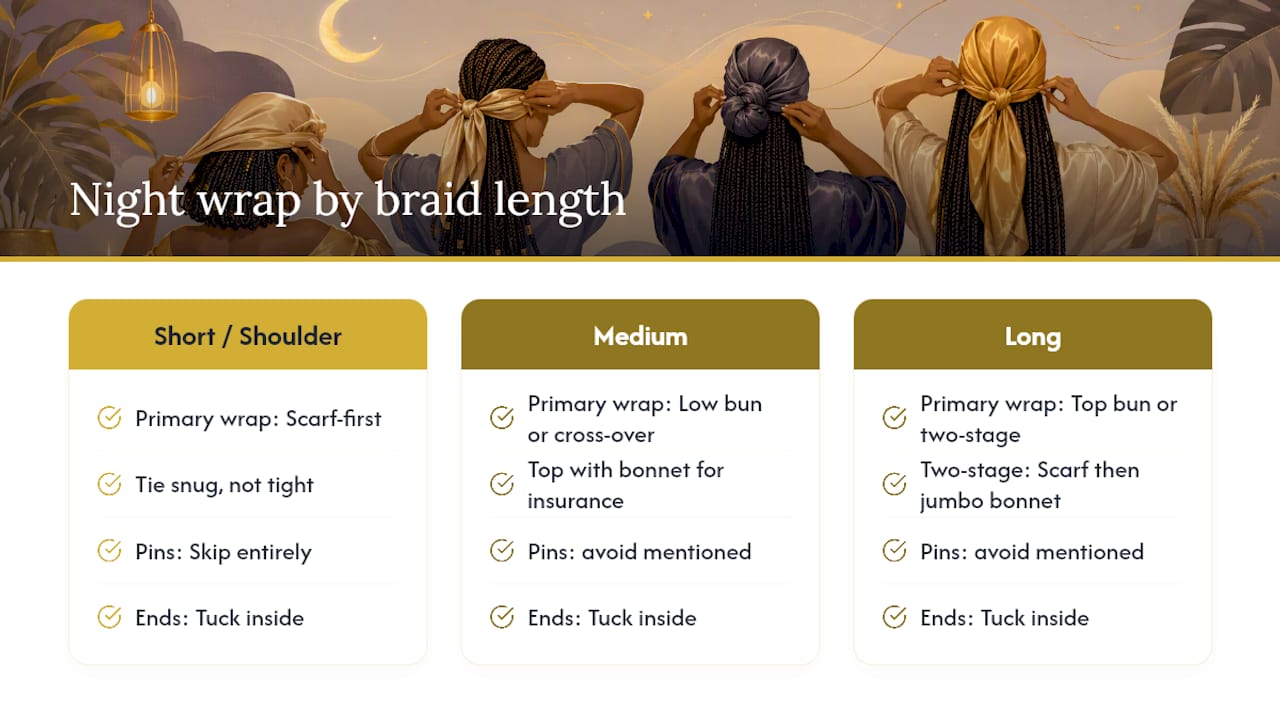
The right technique changes with length, and forcing a method meant for long braids onto a short style just adds bulk you don't need.
Short and shoulder-length braids do best with a scarf-first approach. Tie it snugly but not tight, and skip pins entirely. Pins dig into the scalp over hours of sleep and are one of the more overlooked causes of morning headaches among braid wearers.
Medium-length braids suit a low bun or the cross-over method, topped with a bonnet for insurance. Make sure the ends are tucked in rather than hanging loose outside the wrap, where they catch on bedding and fray faster than the rest of the braid.
Long braids need either a top bun or a two-stage wrap: scarf first, jumbo bonnet second, since standard bonnets often can't hold the extra length without gapping at the edges.
Whatever your length, if you're wearing beads, cuffs, or other accessories, either remove them before bed or make sure your wrap fully covers them. Loose metal or plastic pieces snag on satin just as easily as on cotton, and a snagged bead pulling on a braid overnight is a fast way to loosen the root.
How Do You Protect Your Edges Overnight?
Edges take the most cumulative damage from sleep habits, more than from the actual installation. Cotton pillowcases and tight wraps are the two most common culprits, since cotton grips hair strands and pulls at them with every turn of your head, while a wrap cinched too close to the hairline adds constant low-grade tension for eight hours straight.
Watch for early warning signs: a hairline that feels tender to the touch, small bumps along the edges, or a part that looks slightly wider than it did a few weeks ago. Any of those mean it's time to loosen your wrap and ease up on tight styling near the front.
A few habits protect edges without much extra effort:
- Wash less often than you think you need to. Overwashing strips the scalp and can loosen root attachment faster.
- Skip heavy nightly products directly at the hairline. Buildup there traps residue against follicles.
- Stick to a 4 to 8 week wear window for knotless installs. That's the range most stylists consider safe with proper care, and pushing past it raises the odds of tension damage even with a perfect nightly routine.
Pro Tip: If your edges feel sensitive before week 4, don't wait out the calendar. A partial refresh now costs less than repairing a receding hairline later.
Salon-Tested Tips for Overnight Braid Care
A few small adjustments separate a wrap that holds all night from one that slides off by 2 a.m. These come straight from what actually works in the chair, not just in theory.
- Size your bonnet up, not down. A roomy satin bonnet keeps pressure off the roots, while a tight one dragged over long braids does the opposite of what it's meant to do.
- For very long, heavy installs, anchor the bun loosely at the crown rather than low at the nape. It distributes weight more evenly and reduces the downward pull that adds up over a full night's sleep.
- Around week 4, ask your braider for a light loosen or a partial refresh at the hairline rather than waiting for full re-installation. It's a smaller appointment that extends the life of the style.
Knotless technique already reduces the initial root tension you'd get from traditional braiding, but that advantage only holds up if your nightly routine backs it up. Our expert maintenance guide covers the fuller maintenance schedule beyond just bedtime.
Salon Perspective: Wear Time vs. Edge Health
Every extra week you keep a set in adds a little more cumulative tension, even with a flawless nightly routine. Nightly protection slows the damage. It doesn't stop it entirely, especially at the hairline where the pull is constant regardless of how gently you sleep.
That's why scheduled partial refreshes matter more than chasing maximum wear time. If your edges feel sensitive or your part looks wider than it should, that's your cue to remove or refresh the style early, not to push toward week 8 out of habit. Longevity is worth less than a hairline that's still there in a year.
— Afro
Keep Your Braids Looking Salon-Fresh Between Visits
A nightly wrap routine buys you real protection between appointments, but it can't replace the fit, tension balance, and sizing that come from a professional install in the first place. Professional knotless braid installs with edge-conscious parting and tension from the start reduce the need for nightly bonnet adjustments each morning.

If your edges feel sensitive, if you're carrying long, heavy braids that need better anchoring, or if this is your first time in knotless braids and you want the sizing done right from day one, booking with a stylist who handles this daily makes the difference between a set that lasts and one that fights you every night. Browse real finished looks in our braid portfolio, see what past clients say in our reviews, and book your next appointment when you're ready for a set that's built to sleep well from the start.
Sources
For deeper reading on nightly wrapping and edge protection, see Curlcentric's braid sleep guide, Rush Hair's knotless braid care advice, and ProHair's overnight heatless styling methods.
- How to Sleep With Braids in Your Hair and Not Ruin Them at Night
- How To Sleep With Braids: Sleeping With Braids Tips
- Knotless braids benefits, care & styling advice | Rush Hair
- Are your knotless braids actually protecting your edges? – Edge Naturale
FAQ
What Is the Best Way to Sleep With Knotless Braids?
Wrap dry, lightly moisturized braids in satin or silk using a method that fits your length (triangle, cross-over, or top bun), then cover with a satin bonnet for extra hold.
Can I Sleep With My Braids Overnight Without Any Protection?
You can, but sleeping unprotected on cotton bedding speeds up frizz and edge friction; a satin or silk wrap noticeably cuts down on that damage.
How Long Can You Leave Knotless Braids In?
Most knotless installs last 4 to 8 weeks with proper nightly care, with a light refresh around week 4 helping protect the hairline and extend neatness.
What Is the Healthiest Hairstyle to Sleep In?
Any protective style covered in satin or silk, rather than left loose against cotton, is the healthiest option, since it minimizes friction and moisture loss overnight.
Do I Still Need a Bonnet If I Use a Satin Pillowcase?
A satin pillowcase is a solid backup, but a bonnet or scarf gives more consistent coverage since pillowcases can shift or bunch as you move during sleep.