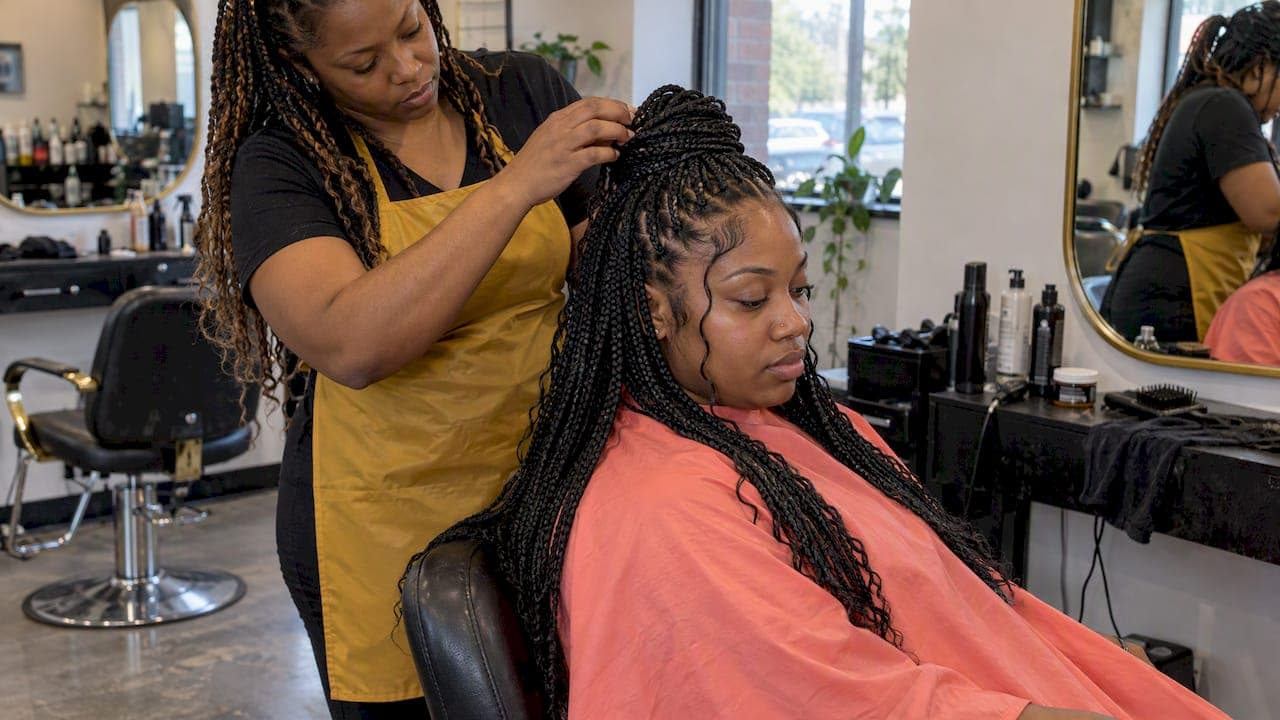
For a polished, face-framing look that works for everyday wear or a special event, split your top section into two even parts and braid each into a half-up ponytail using a knotless, tension-free technique. It is fast, photo-ready, and easy to dress up or down. Below, we walk through the full tutorial, creative variations, and the safety guidance that keeps your hairline healthy.
TL;DR:
- Keeping braid tension moderate and even throughout prevents scalp damage and prolonged tightness that can lead to traction alopecia.
- Using knotless techniques and larger braids on fragile edges reduces the mechanical load on hair follicles, especially for thinning hairlines.
- Styling a half-up half-down braid with a softer hand and careful tension management minimizes hair stress and preserves natural hair health.
- Wearing styles for four to six weeks maximizes protection while allowing the scalp to recover and avoid permanent damage.
- Consulting a professional for complex styles or color placement helps prevent damage and ensures a safe, protective result.
Table of Contents
- What you need before you start braiding
- Step-by-step tutorial for half up half down braids
- Creative variations to try on different hair types
- How to finish and maintain the look day to day
- Tension, wear time, and safer install choices
- Troubleshooting uneven braids and frizz
- Why we braid half up half down styles with a gentler hand
- Book a professional half up half down install
- FAQ
- Sources
What you need before you start braiding
A clean setup makes the difference between a style that looks effortless and one that slips by noon. Before you pick up a single strand, gather your tools and prep your hair texture correctly.
- A rat-tail comb for crisp, straight parts that make the transition between braided and loose hair look intentional.
- Small clips to hold sections out of the way while you work.
- Small elastics in a shade matching your hair, plus an edge brush if you want sleeker lines.
- A lightweight smoothing gel or leave-in conditioner for slippery, easy-to-handle sections, and a texturizer if your hair needs extra grip.
Fresh-washed hair needs a leave-in and a light detangle with a wide-tooth comb before you section, since wet or newly washed strands slip more. Day-two hair often braids tighter and holds longer, but detangle gently from the ends up to avoid snapping fragile strands. Precision sectioning with a rat-tail comb, as hairstylists recommend, gives you much cleaner lines between the braided crown and the hair left down.
Step-by-step tutorial for half up half down braids
This sequence works whether you are braiding your natural hair or adding extensions for a knotless install.
- Create your half-up section. Measure from ear to ear across the crown and clip the rest of your hair out of the way.
- Split the section in two. Use your rat-tail comb to part down the middle, aiming for two equal halves with a clean, straight line.
- Choose your braid type and braid each half. A three-strand braid, Dutch braid, or knotless feed-in all work. Knotless is the gentler option because it starts with your own hair before feeding in extension, spreading tension more evenly at the root.
- Secure and combine. Pull both braids back and tie them together with a small elastic, or wrap one braid around the base to hide the elastic completely.
- Finish the hair left down. Curl it with a curling iron, smooth it with a texturizing spray, or run an edge brush over any flyaways for a polished finish.
Braid with even, moderate tension throughout. A braid that feels tight at the scalp the moment you finish it will only feel tighter as the day goes on, and that is where damage starts, not just discomfort.
Pro Tip: Braid both sides to the same tightness by counting your "stitches," literally counting each cross of the strands so both braids end up with the same number of twists and the same length.
Creative variations to try on different hair types
Once the base technique feels natural, these forks let you adapt the look to your hair, your event, or your mood.
- Front braids feeding into the half-up: Start two thin braids at the hairline on each side and feed them into the main half-up braids for a face-framing effect.
- Half cornrow hybrid: Cornrow the crown section flat against the scalp, then let it merge into fuller box braids below for texture contrast.
- Peekaboo color placement: Peekaboo braids hide contrasting extensions under the main braids, so place colored pieces near the nape and low side panels where they reveal themselves as the half-up moves.
- Braids paired with curls: Leave the bottom section loose and curl it into soft waves for an event-ready, dressed-up version of the same base style.
How to finish and maintain the look day to day
A great braid can still look messy by the afternoon if the "down" hair is not handled right. A few habits keep the whole look intact.
- Pancake the braids gently by loosening the edges of each plait slightly, which adds volume without putting new tension on the root.
- Smooth edges without tightening them, using an edge brush and a light gel rather than a heavy, sticky one that cakes and pulls.
- Protect your style overnight with a silk scarf or bonnet, and keep a small amount of light-hold spray or anti-frizz serum on hand for quick daytime touch-ups.
Loosening braids carefully after installation, a technique known as pancaking, gives a fuller and more natural finish when done without adding root tension.
Tension, wear time, and safer install choices
Tension, not the style name, is what causes damage. The American Academy of Dermatology identifies tight hairstyles, including tight cornrows, micro braids, and heavy extensions, as a cause of traction alopecia, and the risk comes from how much pull is on the follicle, not from whether a style is braided, twisted, or woven.

Board-certified dermatologists note that protective styles are not inherently damaging; the risk comes from heavy extensions, excessive tension, and long wear times, and removing a style on schedule while resting the scalp between installs prevents permanent loss. A typical responsible wear window for extension styles runs about four to six weeks before you should take the style down and let your scalp recover.
A few rules keep your half-up braids on the safer side, reflecting the cultural significance of natural hair styling and protective practices.
- Keep hairline rows looser than the crown rows, since the perimeter is where traction damage shows up first.
- Use medium-sized braids rather than tiny micro-parts along the edges.
- Choose knotless over traditional knotted braids when adding extensions, since it reduces mechanical load at the follicle.
- Switch to larger braids or two-strand twists if your edges are already thinning, since twists generally put less tension on the hairline than three-strand braids.
For more on spacing out perimeter rows if your edges are fragile, our guidance on braids for thin edges covers how to ask for an inch of breathing room at the hairline.
Troubleshooting uneven braids and frizz
A few quick fixes solve most mid-style problems without forcing you to start over.
- Uneven braid? Undo just the last two inches, not the whole plait, and re-cross the strands with matched tension before resecuring.
- Hide elastics cleanly by wrapping a thin strand of hair around the base and tucking the tail under with a bobby pin.
- Refresh next-day texture with a light mist of water and leave-in, then smooth edges again rather than re-wetting the whole braid.
Pro Tip: If frizz keeps creeping back along the part line, that part is likely where tension is lowest, add a drop of smoothing gel there first before touching the rest of the style.
Why we braid half up half down styles with a gentler hand
Knotless methods are often favored for half up half down designs because they start soft at the root and allow tension to build gradually, which matters most right where this style splits the hair. Complex color placement or fragile edges may be reasons to book a professional install rather than go it alone. For more on preventing damage between appointments, see our guide to salon-tested care steps.
— Afro
Book a professional half up half down install
When your half-up vision includes peekaboo color, a cornrow hybrid, or edges that need extra care, a professional set saves time and protects your hairline. Our portfolio of knotless braids, box braids, Fulani braids, and more shows the range of half-and-half designs we build every week, each one shaped around your hair's texture and tension needs.

DIY is a great fit for a quick everyday look, but a salon visit makes more sense when you want intricate parting, color work, or simply do not have an hour to spare on a weekday morning. Ready to see what fits your hair? Book your appointment here or browse our gallery for inspiration before you come in.
FAQ
How do you braid half up half down hair?
Section the top of your hair from ear to ear, split it into two equal parts with a rat-tail comb, then braid each half using a three-strand, Dutch, or knotless technique. Secure both braids together at the back and finish the loose hair with a curl or smoothing brush.
What are peekaboo braids?
Peekaboo braids use hidden, contrasting, or vibrant-colored extensions placed under the main braids, so the color only shows through movement or certain updos. They work well in a half-up style because the color reveals itself naturally as the hair shifts.
Is half up half down still in style?
Half up half down styling remains a flexible, widely worn look because it adapts to casual days, travel, and dressed-up events alike. The base technique stays simple while the variations, from peekaboo color to curled ends, keep it feeling current.
What is this hairstyle called?
It is most often called a half-up half-down braid or half-up braided ponytail, depending on whether the top sections are braided individually or combined into one ponytail. Stylists also describe hybrid versions by their features, like a "cornrow half-up" or "peekaboo half-up."
How much does a professional half-up braided install cost?
Pricing depends on the braid type you choose for the install, such as Knotless Braids or Box Braids, which run $180 to $290, or Boho Braids at $210. Exact pricing varies by hair length, density, and style complexity.
Sources
- AAD on traction alopecia: how tight hairstyles cause hair loss – Edge Naturale
- Do Protective Hairstyles Cause Hair Loss? - Aglow Dermatology
- Hair