
Box braids are one of the most celebrated protective styles in natural hair culture, and for good reason. They honor heritage, offer weeks of low-maintenance wear, and give your natural hair a real break. But great-looking box braids tips often stop at installation and skip the harder parts: how to prep correctly, keep your scalp healthy mid-wear, and take braids down without losing length. Every braid does tell a story, and this guide makes sure yours is one of strength and intention. Here is everything you need to do it right.
Table of Contents
- Key takeaways
- 1. Match your braid size to your hair's strength
- 2. Choose knotless over traditional when possible
- 3. Start your pre-braiding regimen one month out
- 4. Handle your braiding hair safely
- 5. Cleanse your scalp consistently during wear
- 6. Hydrate your natural hair under the braids
- 7. Protect your braids at night
- 8. Vary how you style your braids daily
- 9. Know when to take your braids down
- 10. Remove your braids safely
- My honest take on box braid care
- Ready to wear your braids with confidence?
- FAQ
Key takeaways
| Point | Details |
|---|---|
| Prep hair weeks in advance | Start clarifying and deep conditioning at least one month before installation for stronger, healthier hair. |
| Match braid size to hair density | Sections that are too small overstress follicles; sections that are too large create unwanted weight and bulk. |
| Cleanse your scalp every 1-2 weeks | Use diluted shampoo or a targeted scalp cleanser during wear to prevent buildup, odor, and irritation. |
| Keep wear time to 4-8 weeks max | Exceeding this window increases breakage, matting, and scalp issues that undo the protective benefits. |
| Vary your styling daily | Rotating how you wear your braids reduces repetitive tension on the same follicles and lowers alopecia risk. |
1. Match your braid size to your hair's strength
Before you sit down in a braiding chair or begin a DIY install, you need to make one foundational decision: size. It sounds simple, but braid size tied to hair density is one of the most overlooked variables in protective styling. Sections that are too small place extreme stress on individual follicles. Sections that are too large create heavy braids that pull on your scalp all day.
If your natural hair is fine or low-density, medium to large box braids will serve you better than micro or jumbo extremes. Thicker, high-density hair can handle smaller sections but still benefits from medium sizing to reduce overall weight. This one decision affects comfort, longevity, and long-term hair health more than almost anything else.
Pro Tip: Ask your stylist to assess your hair density before deciding on braid size. A skilled braider will adjust section sizing based on your hairline strength, not just the look you want.
2. Choose knotless over traditional when possible
Not all box braids are built the same. Knotless box braids offer less tension at the root than traditional knotted styles because the extension hair is fed in gradually rather than anchored with a tight knot at the base.
That difference in technique is significant. Traditional box braids anchor the extension weight at one point on your scalp from day one. Knotless braids distribute that weight gradually along the length of the braid. For anyone with a sensitive scalp or a history of traction alopecia, knotless is not just a trend. It is a smarter structural choice. You can explore the differences in depth through this braid styles comparison guide.
3. Start your pre-braiding regimen one month out
This is where most people cut corners, and it costs them later. A solid pre-installation hair care regimen includes clarifying early in the month, deep conditioning weekly, and doing a protein treatment one week before your appointment.
Here is a simple four-step pre-braid prep sequence:
- Week 1: Clarify your scalp and strands with a sulfate-based shampoo to remove product buildup.
- Weeks 2 and 3: Deep condition once per week, focusing on moisture restoration and elasticity.
- Week 4: Do a protein treatment to strengthen the hair shaft before the tension of braiding.
- Day before: Detangle thoroughly, moisturize, and stretch your hair if you want a neater installation.
Skipping this prep is like painting without priming. The finish never holds as well.
Pro Tip: Do not install box braids on wet or freshly washed hair without stretching first. Damp hair is more vulnerable to breakage under braid tension. Let it air dry or blow dry on low before your appointment.
| Prep Step | Timing | Purpose |
|---|---|---|
| Clarifying shampoo | 3-4 weeks before | Remove buildup, reset scalp |
| Weekly deep conditioning | Weeks 2 and 3 | Restore moisture and elasticity |
| Protein treatment | 1 week before | Strengthen hair shaft before tension |
| Detangle and moisturize | Day before install | Reduce breakage during braiding |
4. Handle your braiding hair safely
This one flies under the radar for most people, but synthetic braiding hair can carry heavy metals and VOCs that you should limit your exposure to. The habit of holding synthetic hair in your mouth while braiding is common but worth stopping.
Wearing gloves during installation and avoiding burning the ends of braids directly reduces chemical exposure. Safe alternatives to burning include dipping braid ends in hot water or sealing them with small rubber bands. Pre-stretched braiding hair also tends to have a cleaner finish and is easier to work with. Learn more about your options in this pre-stretched braiding hair guide.
5. Cleanse your scalp consistently during wear
This is one of the most critical tips for healthy braided hair and also one of the most neglected. A clean scalp during box braid wear is not a luxury. It is a requirement if you want your natural hair to stay healthy underneath the style.
Cleanse your scalp every one to two weeks using diluted shampoo or a targeted scalp cleanser applied directly through the braids. The key is to work in sections, applying the cleanser to your scalp and rinsing thoroughly without disturbing braid structure by rough scrubbing.
A handy tool: a small applicator bottle with a nozzle tip lets you direct product exactly where it needs to go without soaking your entire braid. Follow up with a lightweight scalp oil to soothe any dryness.
6. Hydrate your natural hair under the braids
Moisture is the most overlooked factor in protective style health. Regular hydration under braids prevents dry, brittle strands from breaking off at the root once you take your style down. You worked hard to retain that length. Do not let the inside of your braids go dry.
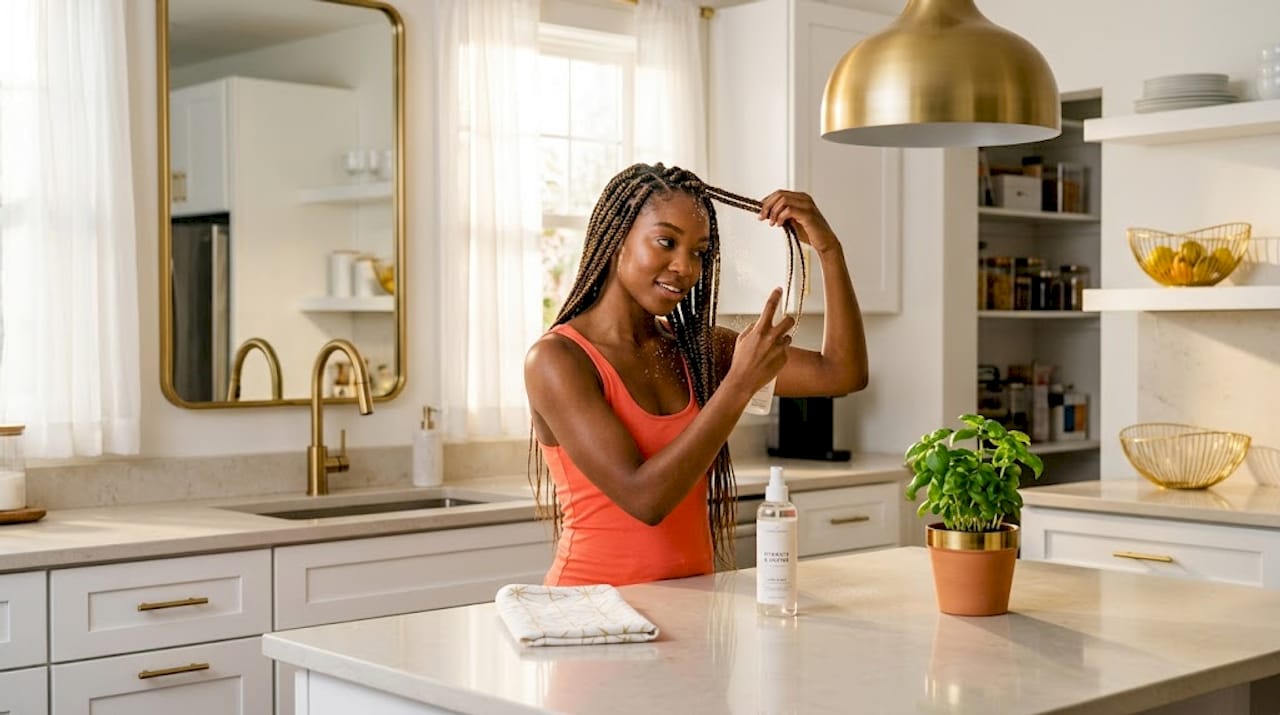
Use a lightweight leave-in conditioner spray or a water-based braid spray two to three times per week. Focus on your natural hair at the root and the length of your strands inside the braid, not just the external synthetic hair. Heavier creams and gels feel moisturizing but cause product buildup that leads to scalp irritation, odor, and an early forced takedown. Less is genuinely more here.
7. Protect your braids at night
Nighttime protection is one of those box braids tips that separates people who consistently retain length from those who always seem stuck at the same point. Cotton pillowcases pull moisture from your braids and create frizz. A satin or silk pillowcase, or a satin-lined bonnet, keeps your style intact and your hair hydrated through the night.
For longer braids, loosely gather them into a pineapple on top of your head before covering with a bonnet. This prevents the braids from being compressed under your body weight all night, which contributes to frizz and deformation of the braid pattern near the root.
8. Vary how you style your braids daily
Wearing your braids in the same tight ponytail or bun every single day is a form of self-inflicted traction. Varying your styling method daily prevents constant tension on the same follicles and significantly reduces your risk of traction alopecia along the hairline and temples.
Here are smart styling rotations to keep your look fresh without stressing your scalp:
- Wear braids loose on some days to give your scalp a full rest.
- Alternate between a half-up style, a low bun, and a loose gathered look throughout the week.
- When doing a ponytail or updo, use a soft fabric band, not a tight elastic.
- Avoid styles that pull aggressively at the nape or edges, which are the most vulnerable areas.
Exploring top box braids styles that work with your hair length can help you build a rotation that protects without boring you.
9. Know when to take your braids down
Box braids are a seasonal styling choice, not a permanent state. The maximum recommended wear time is four to eight weeks before your natural hair and scalp need to recover. Exceeding that window leads to matting, excessive shedding, and the exact kind of breakage that protective styling is supposed to prevent.
Watch for these signs that it is time to take your braids down:
- Significant frizz throughout the length of the braids, not just at the roots.
- Persistent scalp itching, flaking, or discomfort that does not resolve after cleansing.
- Visible buildup at the root or along the braid.
- New growth that has grown out more than an inch, causing tension at the root.
- Any thin or tender spots forming along your hairline or part lines.
Refreshing the perimeter can extend your style slightly, but if you do touch up new growth, limit twisting to three times maximum to avoid matting that makes takedown painful.
10. Remove your braids safely
Takedown is where months of retained length can be lost in an hour if you rush. The goal is patience, lubrication, and working section by section. Apply a generous amount of oil or a slippery conditioner to each braid before you begin unraveling. This careful, section-by-section detangling minimizes breakage and supports the length retention that made wearing braids worthwhile in the first place.
Work from the ends upward. Never pull, force, or rush. After full removal, follow with a thorough clarifying wash, a deep conditioning session, and a light protein treatment to rebuild what the braids may have depleted.
My honest take on box braid care
I have seen what happens on both ends of the spectrum: clients who come in with hair thriving after weeks in braids, and clients who come in with thinning edges and a confused look on their face because they thought they were being careful. Here is what I have genuinely learned from being close to this work.
The advice to "keep braids tight for longevity" is one of the most damaging myths in the game. Tight does not mean neat, and neat does not mean healthy. I have watched perfectly done braids cause real hairline damage because no one told the client to stop pulling her style back every morning. The tension compounds daily, and your edges will quietly tell you before your scalp does.
What actually works? A consistent scalp care routine, moisture you can feel, and the discipline to take braids down before your hair forces the issue. The clients I see come back with the healthiest hair are the ones who treat braiding as a cycle with real rest periods in between, not a lifestyle that never ends.
— Afro
Ready to wear your braids with confidence?
At Afromagicbraiding, every braid is installed with your hair health in mind, not just the finished look. We specialize in knotless and traditional box braids using a tension-free feed-in approach that keeps your scalp comfortable from day one.

Whether you are new to protective styles or looking to switch up your routine, our team in Southfield, Michigan is ready to walk you through every option. From your first consultation to your final braid, we are here to make sure the experience feels as good as the result. Browse our braid style portfolio to see what is possible, or book your appointment directly and let us take care of the rest.
FAQ
How long should you keep box braids in?
The recommended wear time for box braids is four to eight weeks. Keeping them longer increases the risk of matting, breakage, and scalp irritation.
How do you keep your scalp clean with box braids?
Cleanse your scalp every one to two weeks using diluted shampoo or a targeted scalp cleanser applied through the braids with a nozzle applicator, then rinse thoroughly.
What should you do before getting box braids?
Start a prep regimen one month before installation: clarify, deep condition weekly, do a protein treatment one week out, and detangle and moisturize the day before.
How do you remove box braids without breakage?
Apply oil or a slippery conditioner to each braid before unraveling, work from the ends upward, and detangle section by section patiently to retain length and minimize shedding.
Are knotless box braids healthier than traditional box braids?
Yes. Knotless box braids distribute extension weight gradually rather than anchoring it at the root with a knot, which reduces tension and lowers the risk of traction alopecia.