
If you have ever sat in a braiding chair and winced through hours of tight, knotted roots only to wake up the next morning with a sore scalp and tender edges, you already know the frustration that comes with traditional protective styles. What are knotless braids? They are the answer to that pain. This modern technique starts with your natural hair and gradually feeds in extensions, skipping the tight knot at the root that causes so much discomfort. In this guide, we cover exactly how they work, how they compare to traditional box braids, what to expect cost and time wise in Southfield, and how to keep your style fresh and your hair healthy.
Table of Contents
- What are knotless braids? Understanding the basics
- How knotless braids compare to traditional box braids
- Installation, cost, and wear time: What to expect
- Maintaining and protecting your knotless braids for healthy hair
- Choosing the right hair and stylist for your knotless braids
- The modern protective style revolution: Why knotless braids matter today
- Get your perfect knotless braids in Southfield today
- Frequently asked questions
Key Takeaways
| Point | Details |
|---|---|
| Knotless braids defined | They use a feed-in method without root knots, creating a natural look with less scalp tension and breakage. |
| Comparison with box braids | Knotless braids take longer and cost more but provide immediate comfort and a smoother base. |
| Installation and cost | Expect 4–8 hours for installation and $150–$350 pricing influenced by braid size, length, and location. |
| Maintenance importance | Proper care during wear and slow, gentle takedown prevents damage and maximizes protective benefits. |
| Choosing hair and stylist | Selecting suitable braiding hair and an experienced stylist ensures flat, seamless results and scalp comfort. |
What are knotless braids? Understanding the basics
Knotless braids are a protective style where the braid begins with your own natural hair, and synthetic hair is added in small sections bit by bit as the braid progresses down the length. There is no knot tied at the scalp root, which is the signature difference from traditional box braids. That absence of a knot is not just a small detail. It changes how weight is distributed across your scalp, how your edges feel immediately after installation, and how natural the finished style looks.
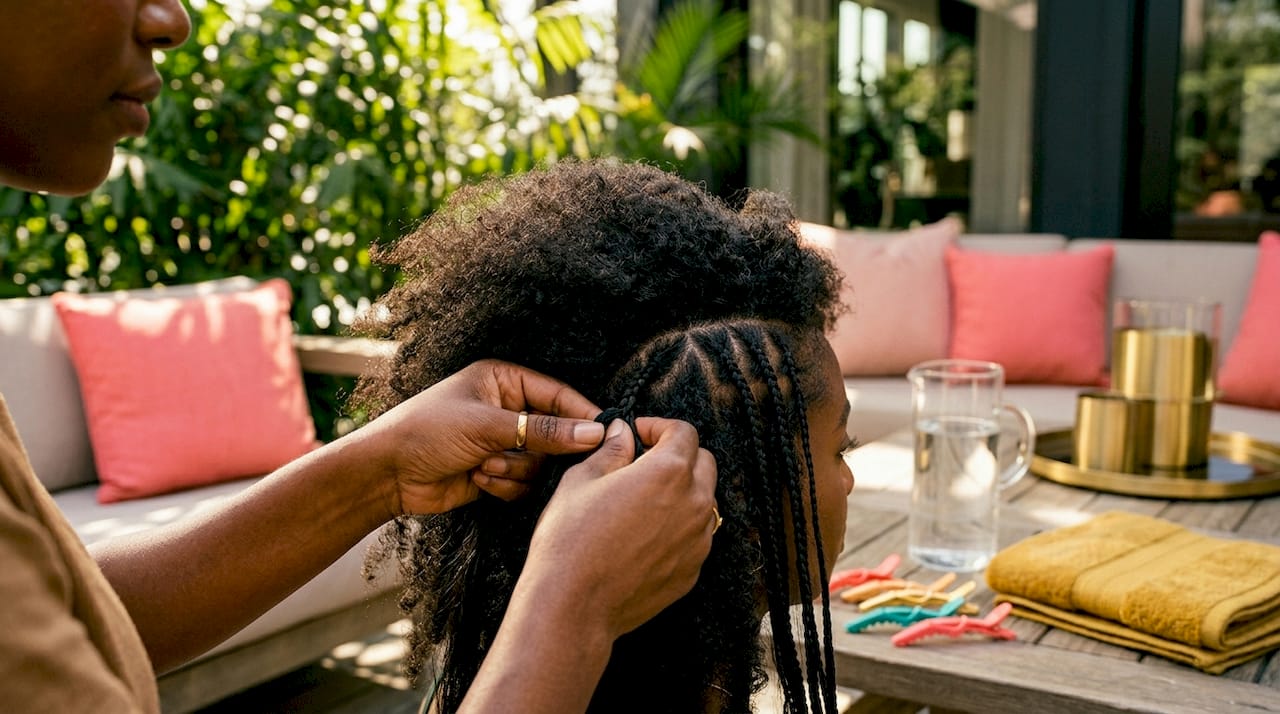
Knotless braids use a feed-in technique with no root knot, creating a more natural look with less tension and breakage than traditional box braids. This matters enormously for women with fragile edges, sensitive scalps, or any history of traction alopecia (hair loss caused by repeated tension on the hairline).
Here is what makes knotless braids stand apart:
- No root knot: Extensions are fed in gradually, so the base of each braid lies flat and smooth against the scalp.
- Reduced tension: Weight builds along the braid length rather than pulling immediately from the root.
- Natural appearance: The transition between your own hair and the extension is nearly invisible.
- Gentle on edges: Especially valuable if your hairline is fine or has thinned from previous styles.
- Versatile foundation: Softer roots allow you to pull hair up into buns and updos right after installation, without the tightness that normally demands a few days of waiting.
If you want a deeper look at styling options once you are installed, our knotless braids style guide covers everything from boho-inspired looks to sleek updos.
How knotless braids compare to traditional box braids
With a clear definition in place, let's unpack how knotless braids measure up against traditional box braids across the factors that actually matter when you are deciding between the two.
The most honest way to think about comparing knotless and box braids is this: box braids are faster and less expensive to install, but knotless braids treat your scalp better and look more natural right away.
| Feature | Knotless braids | Traditional box braids |
|---|---|---|
| Installation time | 4 to 8 hours | 3 to 6 hours |
| Average cost | $150 to $350 | $100 to $250 |
| Scalp tension | Low, gradual weight distribution | High, immediate tension at root |
| Comfort after install | Immediate comfort | Often sore for 1 to 3 days |
| Root appearance | Flat, seamless | Visible knot at base |
| Longevity | 4 to 8 weeks | 4 to 8 weeks |
| Styling flexibility | Updos right away | Usually wait 2 to 3 days |
Knotless braids typically take 4 to 8 hours depending on braid thickness and density, are more expensive due to labor intensity, and feel less tense at the roots compared to box braids. That extra time in the chair reflects genuine skill. The feed-in technique requires a stylist who can control tension with each pass, not just speed through sections.
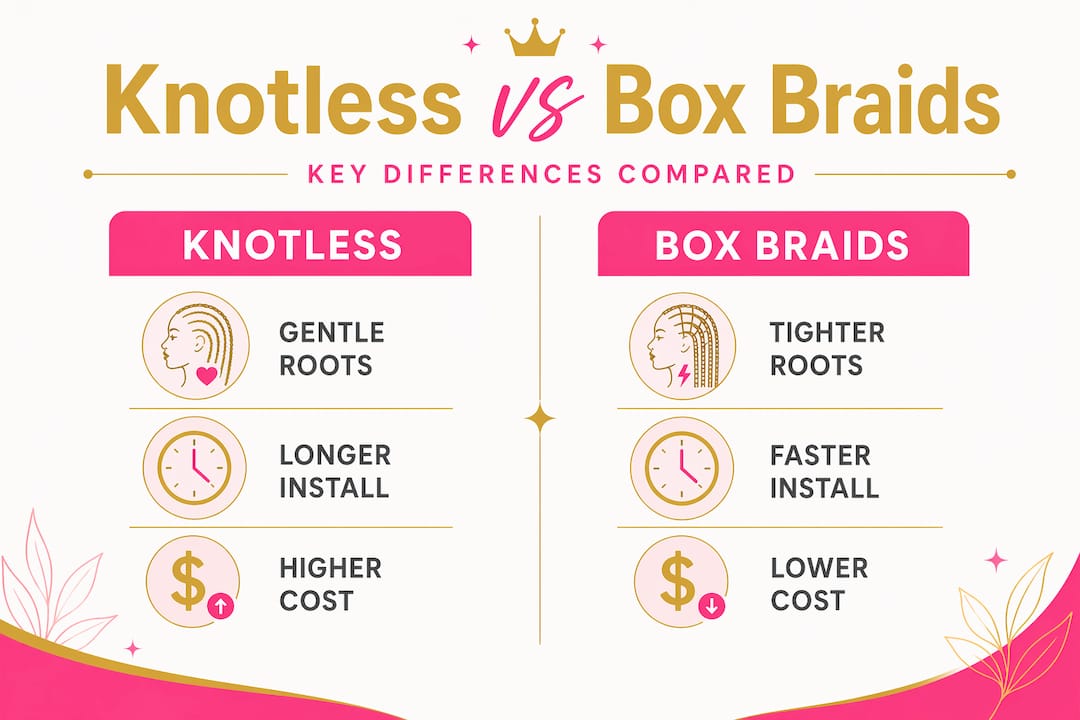
Cost is one area where the difference is noticeable. Knotless braids cost about $150 to $350 depending on length, size, and location. In the Southfield area, you can generally expect pricing in the mid to upper range of that window for medium or small braids.
Key takeaways from the comparison:
- If comfort is your priority, knotless braids win without question.
- If budget or speed is your priority, traditional box braids may serve you better in the short term.
- If you want immediate styling options, knotless braids are far more flexible from day one.
Pro Tip: Ask your stylist to use medium braid sizes if this is your first knotless installation. They install faster than small braids, cost less, and still give you that clean, natural finish without the weight of large braids.
Installation, cost, and wear time: What to expect
Now that you know how knotless braids compare overall, let's get into the practical details about installation, costs here in Southfield, and how long the style actually holds up.
Here is a step-by-step look at what happens during a knotless braid installation:
- Hair prep: Your stylist will assess your natural hair, recommend detangling and moisturizing if needed, and section your hair cleanly to create an even, balanced part pattern.
- Sectioning: Each section of hair is parted into a neat square or diamond shape. Clean parts are the foundation of a beautiful finished look.
- Beginning the braid: Your stylist starts braiding with only your natural hair for the first inch or so, then begins feeding in small pieces of extension hair gradually.
- Feed-in progression: Small amounts of extension hair are added every few passes of the braid, building volume slowly so weight is spread across the full length instead of dropping all at once from the root.
- Finishing and sealing: The ends are sealed to prevent unraveling, typically by dipping them briefly in hot water or using a lighter to carefully seal synthetic fiber ends.
Installation time ranges from 4 to 8 hours depending on braid size and density, with thicker braids being faster to install.
| Braid size | Estimated install time | Approximate cost |
|---|---|---|
| Large braids | 3 to 5 hours | $150 to $200 |
| Medium braids | 5 to 7 hours | $200 to $280 |
| Small or micro braids | 7 to 10+ hours | $280 to $350+ |
Knotless braids usually last 4 to 8 weeks, with duration influenced by your hair growth rate and how consistently you maintain the style. Women with faster hair growth often find 4 to 6 weeks is the sweet spot before the roots begin to look overgrown and bunching starts near the base.
Pro Tip: Schedule your appointment on a day when you have absolutely nothing else planned. Bring snacks, headphones, and a charger. Long installation sessions are much more enjoyable when you are fully comfortable and entertained.
If you are ready to get on the books, you can book knotless braids in Southfield directly through Afro Magic Braiding's online scheduling.
Maintaining and protecting your knotless braids for healthy hair
Understanding installation and wear time is essential, but preserving your hair's health through proper maintenance is equally critical. Here is how to do it right from week one.
The protective value of knotless braids only holds if you care for your hair underneath. Think of maintenance as honoring the work your stylist put in and protecting what your natural hair needs to grow healthy underneath.
Best practices for knotless braid maintenance:
- Moisturize your scalp regularly: Use a lightweight oil or scalp spray two to three times per week. Focus on the roots, not the braid length.
- Protect your edges gently: Even though knotless braids use less tension, avoid tight ponytails or heavy accessories that pull on your hairline.
- Cover your hair at night: Use a satin or silk scarf or bonnet to reduce friction and frizz while you sleep.
- Clean your scalp without disturbing braids: Use a diluted shampoo or scalp rinse every two to three weeks, focusing on the scalp and rinsing gently along the braid length. Let braids air dry fully to avoid mildew.
- Recognize when to take them down: If your roots are lifting more than half an inch, edges are thinning, or you feel persistent tension, it is time to remove the braids. Wearing them past 8 weeks rarely ends well.
Takedown care is just as important as installation care. Proper detangling during takedown prevents excess shedding and breakage. Removing braids slowly with conditioner slip helps prevent tangles from bonding together into knots that can snap your natural hair.
Pro Tip: Apply a generous amount of a moisturizing conditioner or detangling spray to each braid before you begin taking it down. Start from the ends, not the root, and work your way up slowly.
Our knotless braids maintenance guide and protective style care tips go deeper into building a routine that keeps your natural hair thriving through every style.
Choosing the right hair and stylist for your knotless braids
Beyond care, your choice of hair and stylist shapes the outcome more than most people realize. Let's cover what actually matters when making these decisions.
Choosing the right braiding hair matters for the knotless style end result. Experts recommend hair that is easy to separate and resembles your natural hair texture for the most convincing blend.
What to look for in braiding hair for knotless braids:
- Texture match: Hair that mimics your natural curl pattern or texture blends more naturally at the feed-in point and reduces bulk at the root.
- Ease of separation: Tangled or tightly packed bundles make the feed-in process harder and can cause lumpy braids. Pre-stretched hair is particularly popular for this reason.
- Weight considerations: Lighter hair means less tension on the scalp. This matters most for long or small braids where the weight builds significantly.
- Knotless braiding hair comparison: For most knotless braid styles, pre-stretched synthetic braid hair or soft yaki-textured hair performs best. If you want a boho or wavy finish, look for braiding hair supplies for boho styles with a wavy or curly end section built in.
When choosing your stylist, these are the non-negotiable questions to ask:
- How do you start your knotless braids? The answer should describe starting with your own natural hair before any extensions are added.
- How do you manage tension at the hairline? A skilled stylist uses noticeably lighter tension near the edges compared to the crown.
- Can I see your recent work? Portfolio photos are your best window into actual results, not just what a stylist can do on their best day but what they do consistently.
In Southfield, the best stylists for this technique stay current with both classic knotless braided hairstyles and modern variations like boho braids or Fulani-inspired braids with thread accents. For guidance on the best hair for knotless braids, check out our breakdown of best hair for knotless braids.
Pro Tip: Bring reference photos to your consultation, not just of the style you want but also photos of styles you have loved and ones you have disliked. Context helps your stylist understand your aesthetic, not just your requested braid size.
The modern protective style revolution: Why knotless braids matter today
Having covered how to choose hair and stylists, here is an honest perspective on why knotless braids represent something bigger than just a trendy protective style.
For decades, tight root knots were considered part of the deal with box braids. You sat through the pain, took some ibuprofen, and waited a few days for the tension to ease. That experience was treated as normal. It is not normal. It is a design flaw, and the feed-in method of knotless braids reduces scalp tension and breakage, making them an ideal protective style for sensitive edges and hair growth.
What most guides miss is this: the value of knotless braids is not just physical comfort. It is the signal they send about how we treat our hair overall. When you choose a style that respects your scalp, you are making a choice that compounds over time. Healthy edges stay healthy. Hair grows instead of breaking at the line. The protective style actually protects, rather than trading one problem for another.
We have also seen a shift in what clients in Southfield are asking for. Five years ago, box braids were the default request. Today, clients arrive with nuanced questions about feed-in technique, pre-stretched hair, and how to preserve their hairline through repeated protective styles. That is a genuine cultural shift in how Black women think about hair health as self-care, not just aesthetics.
The uncomfortable truth is that not every stylist who offers knotless braids has truly mastered the technique. A stylist who rushes the feed-in, pulls the starting section too tight, or packs in too much extension hair at once creates lumpy, uncomfortable results that defeat the purpose entirely. Speed is not a virtue in knotless braiding. Precision is.
If you are exploring the full range of what this protective style revolution looks like, the styling possibilities go far beyond basic braids into boho, tribal, and goddess-inspired looks that celebrate heritage while honoring your hair's health.
Get your perfect knotless braids in Southfield today
Ready to experience the benefits of knotless braids for yourself? At Afro Magic Braiding, our stylists specialize in the precise feed-in technique that makes knotless braids so worth it, done with care for your scalp, your edges, and your personal style.
Browse our Afro Magic Braiding portfolio to find a style that excites you, from classic medium knotless braids to vibrant boho looks with curly ends. When you are ready, booking is simple through our online scheduler. Our customer reviews reflect the consistent quality and care our clients experience every visit. Whether you are new to protective styles or a longtime braids lover looking for a better experience, we are here to make every braid tell your story. Book your appointment today and let us show you the difference that real technique makes.
Frequently asked questions
How long does it usually take to install knotless braids?
Installation generally takes between 4 to 8 hours depending on braid size and complexity, with thicker braids being quicker to install. Knotless braids take 4 to 8 hours depending on braid thickness and density.
How long do knotless braids last with proper care?
Knotless braids typically last 4 to 8 weeks, varying with your hair growth rate and how well you maintain the style. Knotless braids last about 4 to 8 weeks depending on individual habits and hair growth.
Are knotless braids better for sensitive scalps compared to box braids?
Yes, knotless braids distribute tension more evenly and do not use root knots, making them gentler and more comfortable for sensitive scalps. Knotless braids use no root knot, creating less tension and breakage than traditional box braids.
Why do knotless braids cost more than traditional box braids?
They require more time and skill to install due to the gradual feed-in technique, which increases labor and thus cost. Knotless braids typically cost $150 to $350 because installation is more labor-intensive.
What should I look for when choosing braiding hair for knotless braids?
Choose hair that matches your natural texture, is easy to separate, and blends well to achieve a natural look and seamless feed-in technique. Choosing the right braiding hair matters for the knotless style end result, with experts recommending hair easy to braid and resembling natural texture.