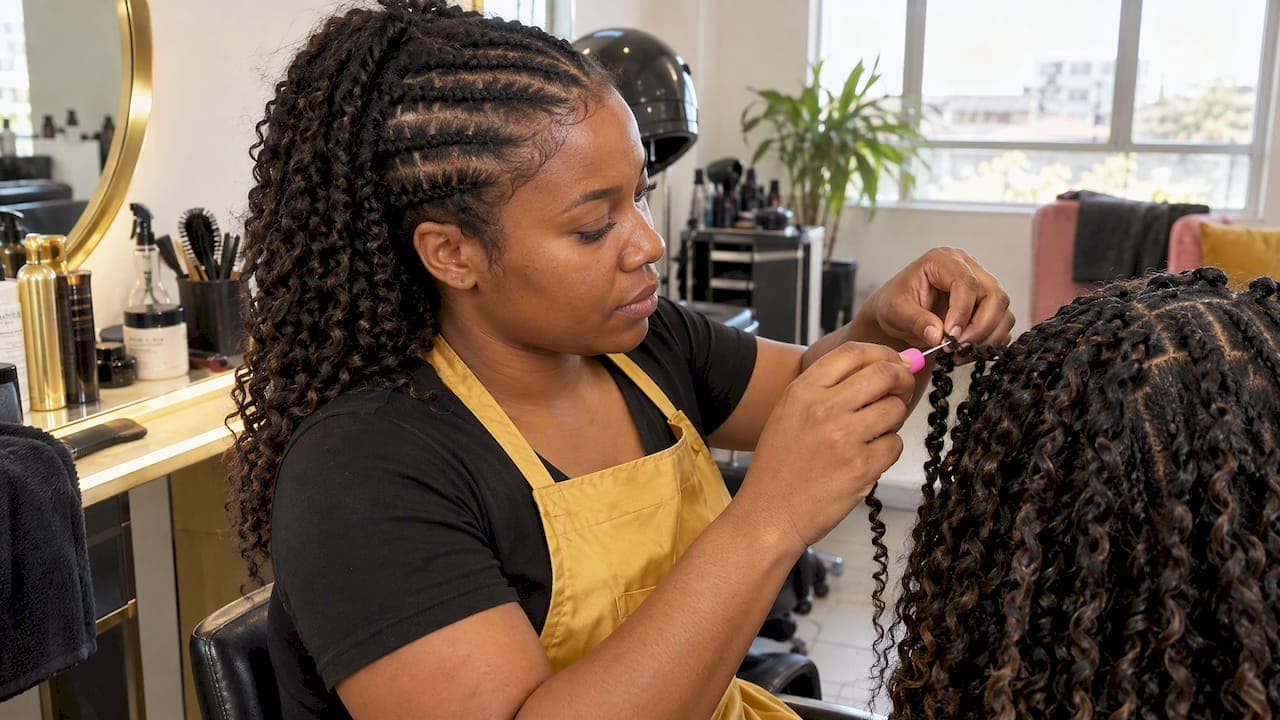
Crochet passion twists are two-strand boho twists made from water-wave textured hair, looped onto braided foundations for a lightweight, protective finish with soft, piece-y curl. Beginners who follow a careful step-by-step process can install them at home and save money, but booking a salon makes sense when you want a flawless finish fast or have fragile edges that need expert hands.
TL;DR:
- Using synthetic water-wave braiding hair is recommended, with about seven packs for an average full head, depending on length and density.
- Maintaining loose root tension and small, even sections during installation helps prevent traction and breakage.
- Passion twists typically last between 4 to 8 weeks with proper care, but should be removed before 12 weeks to avoid damage.
- DIY installation is accessible for beginners with step-by-step techniques, but booking a professional improves finish and protects fragile edges.
- Speeding up installation with miracle knots reduces time but may compromise style longevity and can create small bumps or loosen over time.
Table of Contents
- What Passion Twists Are and How They Differ From Similar Styles
- Materials and Prep You Need Before You Start
- Step-by-Step Crochet Installation for Beginners
- Cheat Methods and the Miracle Knot Shortcut
- Styling Ideas to Finish Your Look
- Maintenance, Care, and How Long They Really Last
- Choosing Pre-Looped Versus Loose Hair Bundles
- Salon-Backed Tips From Afro Magic Braiding
- What I Tell Every First-Timer About DIY Twists
- Book a Passion Twist Install or Shop Products With Afro Magic Braiding
- FAQ
- Sources
What Passion Twists Are and How They Differ From Similar Styles
Passion twists were created by Miami hairstylist Kailyn Rogers, known as The Boho Babe, and they built the style around water-wave textured hair to get that tousled, semi-unraveled curl pattern that reads as boho rather than polished. The hair twists into an S-shape instead of lying flat and tight, which is the detail that separates passion twists from most other protective styles at a glance, according to Byrdie's guide to passion twists.
Spring twists use a coilier, springier texture that bounces instead of waving, and they tend to sit closer to the scalp with a denser, more compact curl. Faux locs mimic the look of loose dreadlocks and usually carry more weight per strand since they wrap thicker sections, which can mean more tension at the root if they are installed too tightly. Senegalese twists use smooth, straight kanekalon and have a sleek, rope-like finish that is the opposite of the textured, undone look passion twists are known for.

What ties all of these styles together is that they protect your natural hair underneath by keeping it braided and moisturized instead of exposed to daily manipulation. Passion twists earn their popularity because they manage that protection while staying noticeably lighter on the scalp, a quality that matters if you have had tension headaches or thinning edges from past styles. The boho, piece-y texture also means less pulling during installation since the hair does not need to be gripped as tightly to hold its shape.
Materials and Prep You Need Before You Start
Water-wave braiding hair is the standard choice because its texture blends naturally into the S-shaped twist, and you can choose synthetic fiber for affordability or human hair blends if you want a softer feel and more heat tolerance. Pre-looped packs save time since the loops are already formed, while loose bundles give you more control over twist size and placement.
Gather these before you sit down to install:
- A crochet hook sized for braiding hair, usually a 0.5mm to 1.0mm latch or standard crochet hook.
- A rat-tail comb for clean, even parting.
- Duckbill clips to section hair out of your way.
- Edge control for laying baby hairs and smoothing the hairline.
- A light-hold mousse to set and define the twist curl.
- Sharp scissors for trimming loose ends.
Pack counts depend on length and density. A short style typically needs 4 to 6 packs, a medium length runs 6 to 8, and long or voluminous installs can take 8 to 10 or more. Byrdie notes that about seven packs covers average density for a full head, with denser or coarser natural hair sometimes needing an extra pack or two to avoid thin, see-through sections.
Before you begin, wash and deep condition your hair, detangle thoroughly, and either stretch or blow-dry it so the crochet hook can glide through sections without snagging. Part your hair into clean, evenly spaced rows, since uneven sectioning is one of the most common reasons a finished style looks lopsided.
Step-by-Step Crochet Installation for Beginners
You have two foundation choices: individual single braids or cornrows. Single braids give you more flexibility in twist placement and are easier for a first-timer to manage one section at a time. Cornrows work better if you want a flatter base and plan to part your style in multiple directions later, since the rows stay secure under more pulling and restyling.
Here is the process from start to finish:
- Section your hair into small, even parts no wider than half an inch, since smaller sections distribute tension more evenly and reduce strain at the root.
- Braid or cornrow the sectioned hair close to the scalp, leaving the braid loose enough that it does not pull at the hairline.
- Insert your crochet hook under the braid and loop a strand of water-wave hair through, pulling the loop partway so both ends are even.
- Secure the loop at the base of the braid with a small knot or by wrapping the hair once around itself, which anchors the extension without adding bulk.
- Divide the looped hair into two strands and begin twisting in a consistent direction, letting the natural wave texture create the S-shaped pattern as you go.
- Continue twisting down the length of the hair, checking periodically that the tension stays even and the twist does not unravel from the base.
- Seal the end by dipping it in warm water, applying a small amount of mousse, or using a rubber band temporarily until the twist sets.
- Trim any uneven ends once the full row is complete for a clean, blended finish.
Keep root tension loose enough that you can slide a finger under the braid without resistance. Tight anchoring at the scalp is the single biggest cause of traction and breakage in crochet styles, so err on the side of looser rather than tighter every time you are unsure.
A full head typically takes 3 to 6 hours depending on density and your speed with the hook, with each row taking a few minutes once you find a rhythm. Expect your first few rows to be slower as you adjust to the motion.
Pro Tip: If a loop keeps slipping, your braid foundation is probably too loose. Tighten that one braid slightly before reinserting the hook rather than compensating with the twist itself.
Slippage and uneven twist size are the two problems beginners hit most. Slippage usually traces back to a braid foundation that was not tight enough to hold the loop, while uneven twists come from inconsistent section sizing. Pausing to compare each finished row against the last one keeps the whole head looking uniform instead of catching the mismatch after you have moved on to a new area. For a deeper technique breakdown, this boho twist style guide covers sectioning and crocheting in more detail.
Cheat Methods and the Miracle Knot Shortcut
Miracle knots are a crochet shortcut that tutorial creators popularized to cut install time, and they work by securing the extension hair to the braid with a quick locking knot instead of the standard wrap-and-twist anchor. According to Allure's reporting on miracle knots, these methods evolved specifically to speed up at-home installs while still producing a boho finish close to what a salon delivers.
The appeal is obvious if you are working against the clock or still building confidence with a crochet hook:
- Cuts total install time since you skip some of the manual twisting steps.
- Lowers the learning curve for first-time DIYers who find traditional methods fiddly.
- Pairs well with a braided single-plait foundation for a neater, more secure base.
The trade-off is durability. Knotted installs can come loose faster than twists anchored the traditional way, and the knot itself sometimes creates a small bump that shows through thinner sections of hair. Water-wave textures with a bit of natural grip tend to hold a miracle knot better than silkier, straighter fibers, which can slip free more easily. If you are chasing speed over longevity, a cheat method is a reasonable trade, but know you may be refreshing sooner than the 4 to 8 week range a traditional install offers.
Styling Ideas to Finish Your Look
Passion twists adapt to almost any styling mood once they are installed. A few favorites:
- Bob length: trim twists to chin or shoulder length for a lower-maintenance, lighter feel.
- Ombré color: blend two shades of water-wave hair, darker at the root and lighter toward the ends, for dimension.
- Half-up style: gather the top section into a claw clip or loose knot while leaving the rest down.
- High ponytail: wrap a small section of twist hair around the base to hide any elastic.
Finishing touches matter as much as the twist itself. Thin out overly bulky ends with scissors for a more natural taper, and steam-set or hot-water-dip curls for definition that lasts through the first week. Sleeking your edges with a boar-bristle brush and a light edge control gives the style a more pulled-together look without weighing down the twist texture. For more finishing inspiration, see this guide to curly-ends styling.
Maintenance, Care, and How Long They Really Last
Protect your investment at night by wrapping your hair in a satin or silk bonnet, or pineappling longer twists into a loose top knot to keep them from frizzing against a cotton pillowcase. A satin pillowcase works as a backup if you skip the bonnet some nights.
Weekly care should include:
- A light moisturizing spray with water, glycerin, and a few drops of oil to combat dryness at the root.
- A scalp cleanse using a diluted shampoo or witch hazel on a cotton pad to remove buildup without soaking the twists.
- A fresh coat of mousse on any twists that have started to frizz or lose their shape.
Passion twists generally last 4 to 8 weeks with proper care, and stylist guidance recommends removing them before the 12-week mark to protect your natural hair underneath. That window gives you time to enjoy the style without risking the matting and tension that come from leaving any protective style in too long.
Watch for excessive frizz at the roots, visible new growth that makes parts look wide, or twists unraveling faster than the rest, all signs it is time to refresh or remove. When you do take them out, work in small sections, apply conditioner or oil to soften the hair, and detangle gently from the ends upward to avoid unnecessary breakage. This guide to braid maintenance walks through the full nightly and weekly routine in more depth.

Choosing Pre-Looped Versus Loose Hair Bundles
Pre-looped packs save time since the hair arrives already folded for the crochet hook, which is a real advantage if you are installing solo and want to move faster through each row. Loose bundles take longer to prep but give you full control over loop size and twist thickness, which matters if you want a particular finished look.
When you are comparing packs, check for:
- Fiber type: synthetic kanekalon is budget-friendly, while human hair blends feel softer and tolerate heat styling.
- Bundle weight and length: heavier packs generally yield fuller twists but cost more per bundle.
- Loop consistency: uneven pre-made loops lead to mismatched twist sizes across the head.
- Seller transparency: clear fiber content and country of origin on the label is a good sign of quality control.
Cheaper packs often shed more and lose their wave pattern faster, which shortens how long your style holds up, so weigh price against how many weeks you want the twists to last. A lightweight styling cream can help smooth frizz on lower-quality fiber if it starts to look rough partway through your wear time.
Salon-Backed Tips From Afro Magic Braiding
Crochet passion twist installs favor looser root tension and smaller, even sections for a softer boho finish that still protects the hairline. Booking a professional makes sense if your hair is dense, you want a flawless, salon-quality result the first time, or you simply do not have hours to spend on a DIY install.
Three things worth asking for: a light-hold mousse rather than a heavy gel for natural movement, a looser anchor at the root for a true boho look instead of a tight, polished twist, and a satin wrap demonstration before you leave so you know how to protect the style at home.
What I Tell Every First-Timer About DIY Twists
Try a single section before you commit to a full head. That one test row tells you more about your tension, your hook technique, and how your specific hair texture behaves than any tutorial can.
If your edges are already fragile or you are unsure about root tension, book a consult instead of guessing. Protecting the hair underneath the style matters more than finishing quickly.
— Afro
Book a Passion Twist Install or Shop Products With Afro Magic Braiding
If a DIY install feels like more than you want to take on this week, a professional salon can offer crochet braids alongside a full menu of protective styles, plus in-salon braiding hair and accessories if you would rather buy quality materials and try the install yourself later.

Before your appointment, wash and detangle your hair the night before so your stylist can start sectioning right away. You can browse past installs in the salon portfolio to get a sense of finish and style options before you book.
Ready to see available times? Book your appointment and let a stylist handle the sectioning, tension, and finish for you.
FAQ
How long do crochet passion twists last?
Crochet passion twists typically last 4 to 8 weeks with consistent nighttime protection and weekly moisturizing. Stylist guidance recommends removing them before 12 weeks to avoid matting and tension on your natural hair.
What is the best passion twist crochet hair?
Water-wave textured braiding hair is the standard choice because its natural curl pattern blends into the S-shaped twist that defines the style, as noted by Byrdie. Human hair blends offer a softer feel and more heat tolerance, while synthetic kanekalon is the more budget-friendly option.
How many packs of passion twist hair do I need for crochet?
Pack counts depend on length and density: short styles generally need 4 to 6 packs, medium lengths run 6 to 8, and long or voluminous installs can take 8 to 10 or more. Byrdie notes that about seven packs covers average density for a full head.
What is the difference between spring twists and passion twists?
Spring twists use a coilier, springier texture that sits closer to the scalp, while passion twists use water-wave hair for a looser, S-shaped boho curl. Passion twists tend to read as softer and more undone, while spring twists hold a tighter, bouncier shape.
Can crochet passion twists damage my natural hair?
Crochet twists are protective when installed with loose root tension and proper section sizing, but tight anchoring at the scalp can cause traction and breakage over time. Keeping sections small, moisturizing weekly, and removing the style before 12 weeks all help protect the hair underneath, according to Byrdie's stylist guidance.
Sources
- What Are Passion Twists? A Guide to the Natural Hairstyle — Byrdie
- Miracle knots give you salon-level boho braids at home — Allure