
Read reviews as a pattern, not a verdict. Before you book, scan at least 5–10 recent comments filtered to your exact service, look for appointment-level details, and check how the salon handles complaints. That combination tells you far more than a star average alone.
Your quick TL;DR checklist:
- Check sample size and recency: a 4.8 rating from 60 reviews is more reliable than a 5.0 from two.
- Filter for your exact service: knotless, box braids, boho, Fulani, or whichever style you want.
- Look for concrete details: "neat parts," "gentle hands," "finished on time," or "braids held 8 weeks."
- Verify photos: compare the salon's portfolio to tagged client photos in real-world lighting.
- Read at least one critical review and the owner's response to it.
Open the most recent reviews for your style right now. Scan for three green flags (neat parts, gentle hands, punctuality) and two red flags (pain or tightness, repeated late arrivals or cancellations). If the green flags show up consistently and no critical red flag repeats, you have a solid signal to book.
Table of Contents
- How to read braiding salon reviews step by step
- What stylist-specific reviews actually tell you
- What salon-level reviews reveal about operations
- Where to find reliable reviews and how to spot fake ones
- Green flags vs. red flags: your quick decision guide
- What to do when reviews are scarce or mixed
- Practical questions to ask before you confirm your booking
- Key Takeaways
- A note from Afromagicbraiding on what we believe reviews should do
- Useful sources and further reading
How to read braiding salon reviews step by step
The practical routine starts with recency. Open the newest reviews first and read the last 5–10 comments before you look at anything else. A single glowing review from three years ago says nothing about who is braiding today. One isolated 1-star complaint matters far less than the same complaint appearing in four separate reviews over the past six months.

Filter by your exact service next. A braider praised for fast installs on simple box braids may not be the right fit for a detailed knotless or boho style that takes eight hours. If you want knotless braids, search for that phrase in the reviews or scroll until you find comments that name it. Generic praise for "great braids" tells you almost nothing about technique or timing for your specific style.
Assess specificity as you read. The most trustworthy reviews name the service, the approximate time spent, and the outcome: "knotless braids, took 6 hours, lasted 8 weeks, parts were clean." That level of detail is hard to fake and gives you a realistic benchmark. Vague praise like "Amazing!" or "Best ever" carries almost no information.
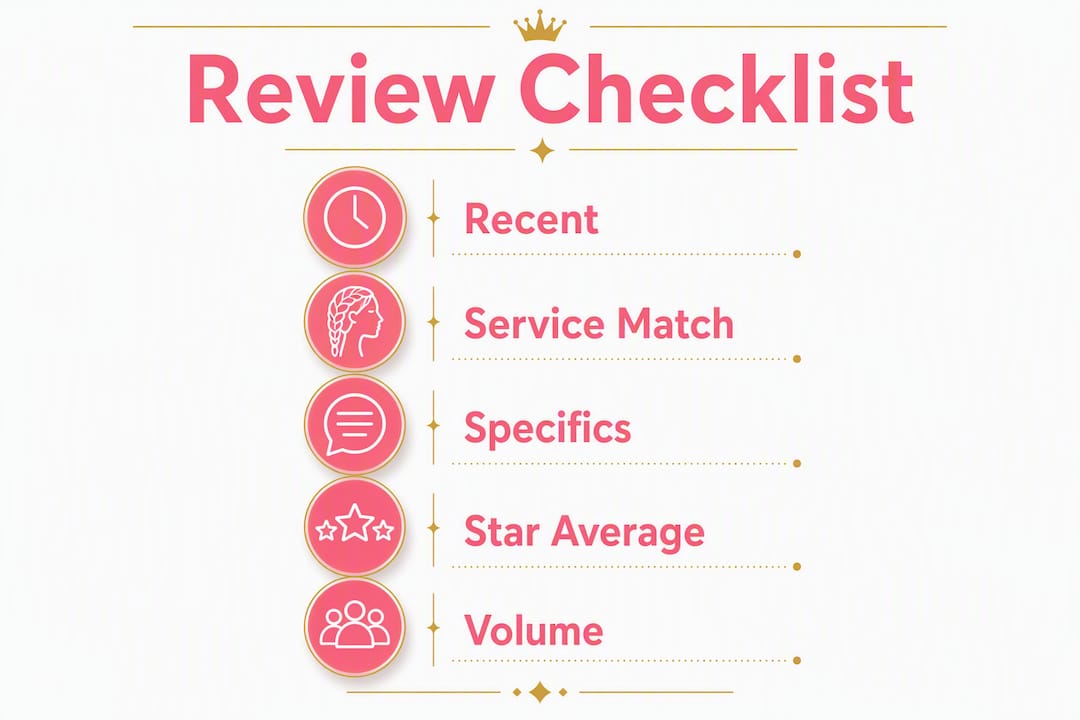
Finally, weigh star averages against volume. A 4.8 from 60 reviews predicts consistent performance far better than a 5.0 from two. Platform signals add another layer: verified-booking badges and payment-backed reviews require a completed transaction before submission, which cuts the risk of fake or incentivized feedback.
What stylist-specific reviews actually tell you
The braider's hands are the whole appointment. Reviews that mention the individual stylist by name, describe a consultation, or note specific technique details are the strongest credibility signals you will find in public feedback.
Green flags to look for in stylist reviews:
- "Neat parts" and "even tension" across the whole head
- "Gentle hands" or "tension-free" technique, especially near the edges
- "Listened to my vision" or "asked questions before starting"
- "Gave me aftercare advice" before you left the chair
- Specific timing: "she took 7 hours and every braid was perfect"
- Longevity notes: "braids held 10 weeks with no frizz"
Red flags about stylist technique:
- Repeated mentions of "painfully tight," "too much tension," or "scalp pain"
- Notes about hair breakage or thinning edges after take-down
- "Didn't follow my instructions" or "ignored my reference photo"
- Rushed installs with no consultation described
Portfolio photos deserve their own scrutiny. Prefer posts where clients are tagged and results are shown in natural, real-world lighting rather than studio-filtered close-ups. Candid shots from multiple angles and across different hair types tell you far more than a single polished image. Compare those tagged client photos to the salon's official portfolio: if the quality gap is large, trust the candid shots.
Reviews that include timing and longevity details help you estimate how thorough the stylist will be for your chosen style. If reviewers consistently report 6–8 hour sessions for full knotless braids, that is a sign the braider takes her time. If multiple people mention a 3-hour install for the same style, ask questions before you commit.

Pro Tip: A review that names the staff member and describes a pre-service consultation is worth three anonymous five-star ratings. It shows the braider treats each client as an individual, not a slot on the schedule.
What salon-level reviews reveal about operations
Beyond the braid itself, reviews tell you whether the shop runs smoothly. Operational consistency shapes your entire experience from the moment you walk in.
Operational green flags:
- Consistent notes about punctuality: "she started right on time"
- Clean workstations and organized product areas mentioned across multiple reviews
- Clear pricing with no surprise charges at checkout
- Friendly, professional front-of-house interactions
- Safe product handling: reviewers mention the braider asked about allergies or sensitivities
Operational red flags:
- Repeated complaints about last-minute cancellations or overbooking
- Multiple mentions of bad odors, poor sanitation, or cluttered stations
- "Hidden fees" or charges that weren't quoted upfront
- Hostile or dismissive front-desk interactions appearing in more than one review
Pay attention to booking friction in the reviews. Comments about confusing deposit policies, long rescheduling waits, or unclear cancellation terms are worth taking seriously, especially if they appear more than once. Scheduling problems tend to repeat. For more context on what to expect from appointment-based versus walk-in salons, the walk-in vs. appointment guide breaks down the tradeoffs clearly.
Cross-check reviewer descriptions against the salon's own photos. If the official gallery shows a spacious, well-lit studio but multiple reviewers describe cramped, chaotic conditions, trust the reviewers. Photos are curated; reviews are not.
Where to find reliable reviews and how to spot fake ones
Cross-checking across at least two platforms is the single most effective way to verify braiding salon feedback. Each platform has different moderation standards, and a salon that looks flawless on one may tell a different story on another.
Where to look:
- Google Business Profile: highest volume, publicly visible owner responses
- Yelp: stronger moderation and a longer review history for established salons
- Facebook: useful for community context and local group recommendations
- StyleSeat and Booksy: platform-verified bookings increase review authenticity
- Instagram: tagged client photos are the most honest visual evidence
- TrustAm: payment-backed review systems require booking and payment before submission
Fake-review red flags:
- A sudden flood of short, generic praise posted within days of each other
- Repetitive phrasing across multiple reviews ("Amazing service, highly recommend!")
- Reviewer profiles with no photo, no history, and only one review ever posted
- A disconnect between glowing text and mediocre portfolio photos
The table below shows which platform signals carry the most weight when you are evaluating a new salon.
| Platform signal | Trust level | Why it matters |
|---|---|---|
| Verified-booking badge | High | Confirms the reviewer actually had an appointment |
| Payment-backed review | High | Requires a completed transaction before submission |
| Tagged client photo | High | Real-world result, hard to fake |
| Owner response to complaint | Medium-High | Shows accountability and professionalism |
| Google review with detail | Medium | High volume, publicly indexed, owner-respondable |
| Anonymous 5-star, no text | Low | No appointment details, easy to fabricate |
How a salon responds to criticism is itself a trust signal. Professional responses that explain policy or offer resolution show the business takes accountability seriously. A page full of only 5-star praise with zero owner engagement on any complaint is actually less credible than a salon with a few 3-star reviews and thoughtful, professional replies.
Pro Tip: Cross-check the salon's Instagram portfolio against tagged client photos. If the official posts are all studio-lit close-ups and the tagged photos show a very different quality level, that gap is the real review.
Green flags vs. red flags: your quick decision guide
Use this side-by-side list as your final filter before you book.
| Green flag | Red flag |
|---|---|
| "Neat parts, even tension" | "Painfully tight," "scalp pain" |
| "Gentle hands, no breakage" | "Hair thinning after take-down" |
| "Started on time, finished as promised" | Repeated late starts or cancellations |
| "Clear pricing, no surprises" | "Hidden fees added at checkout" |
| Verified-booking badge on platform | Flood of generic 5-star reviews, no detail |
| Owner responds to complaints professionally | Complaints ignored or met with hostility |
| Tagged client photos match portfolio | Portfolio photos far better than tagged results |
Quick decision rule: require at least two strong green flags relevant to your service and zero recurring critical red flags around pain, safety, or sanitation. One bad review about a long wait is not a dealbreaker. Three reviews about scalp pain or tightness absolutely is.
Watch the language closely. Phrases like "she listened to exactly what I wanted" or "my edges are still intact after 10 weeks" carry real information. Phrases like "Amazing!" or "Best braider ever!" with nothing else are low-information and should not move the needle either way.
What to do when reviews are scarce or mixed
Treat a review pattern as meaningful once you can read 5–10 recent, service-specific comments or see consistent portfolio evidence. Fewer than five reviews for your exact style is not enough to judge.
When reviews are thin, reach out directly. Politely DMing a tagged client on Instagram often yields clearer insight than a dozen public ratings. Here is a short script you can copy:
Before booking, you can also send the salon a short message:
How to weigh mixed reviews:
- Prioritize operational and safety complaints over isolated aesthetic ones. One person who disliked the color of the extensions is not the same as three people who reported scalp pain.
- Look for owner responses and offered remedies. A salon that responds with "We'd love to make this right, please contact us" is demonstrating accountability.
- A business with no negative reviews at all may be less credible than one showing balanced feedback plus professional replies.
- Read the most critical reviews first, not the best ones.
- Check whether the complaint is isolated or a pattern.
- Look for the owner's response and whether it offers a resolution.
- If the owner never responds to any complaint, factor that into your decision.
- When reviews are under five for your style, use the DM script above before committing to a deposit.
Practical questions to ask before you confirm your booking
Reading reviews gets you to 80% confidence. The final 20% comes from a direct conversation with the salon. Before you confirm, ask these questions:
- What is the exact service name and estimated time for my hair length and type?
- What extension type and length do you recommend for the style I want?
- What is the deposit amount and your cancellation policy?
- Who will be braiding my hair, and can I see their recent work?
- Do you accept reference photos, and will we review them together before starting?
- What aftercare do you recommend for this style?
Confirm the total cost or pricing structure upfront. Many salons price by length, hair volume, or add-on extension costs, so "starting at" prices can shift. The braiding salon pricing guide explains what drives price differences so you know what questions to ask.
For tipping, the standard range in U.S. salon culture runs 15–25%. Tip toward the higher end for long sessions, exceptional care, or when the braider went beyond the original scope. Always request appointment confirmation via text or email and save any portfolio photos you discussed so you have a reference at the chair.
Key Takeaways
Reading braiding salon reviews well means treating them as a pattern: filter by your exact service, prioritize specific appointment details, verify photos, and always check how the salon handles complaints before you book.
| Point | Details |
|---|---|
| Read reviews as a pattern | Scan 5–10 recent, service-specific comments rather than relying on a single star rating. |
| Filter by exact service | Search for your style (knotless, box, boho) to find relevant feedback, not generic praise. |
| Prioritize specific details | Reviews naming service, time, and outcome ("braids held 8 weeks") are far more reliable than one-word ratings. |
| Verify photos and responses | Compare tagged client photos to the portfolio, and check that the salon responds professionally to complaints. |
| Ask before you book | Confirm pricing, timing, deposit policy, and who will braid you before committing. |
A note from Afromagicbraiding on what we believe reviews should do
Every braid tells a story, and at Afromagicbraiding we believe the reviews left by our clients should tell yours honestly. Our approach starts before you ever sit in the chair: we prioritize a real consultation, discuss your hair health and protective styling goals, and walk you through pricing and timing so there are no surprises. We use client photos and feedback actively, not just to showcase results but to keep improving the experience for every person who books with us.
Our salon portfolio includes real client work across knotless braids, box braids, Fulani braids, boho styles, and more, so you can compare what we do against what you read in reviews elsewhere. When you are ready to see what our clients say directly, our reviews section is the honest place to start. And when you are ready to book, we are here.
Useful sources and further reading
The guidance in this article draws on the following resources. Each one is worth bookmarking if you want to go deeper on a specific topic.
- Why salon owners must master online reviews (Dingg) — details why owner responses are a trust signal and what accountability looks like in practice.
- Hair braiding 101: knotless, boho, box braids (The Cut) — helps you match review language to the exact style you are requesting.
- How to find a braiding salon nearby: 2026 guide (Afromagicbraiding) — local discovery and platform advice for Southfield, MI and surrounding areas.
- How to book a braiding appointment the right way (Afromagicbraiding) — the pre-appointment checklist to use once your review research is done.